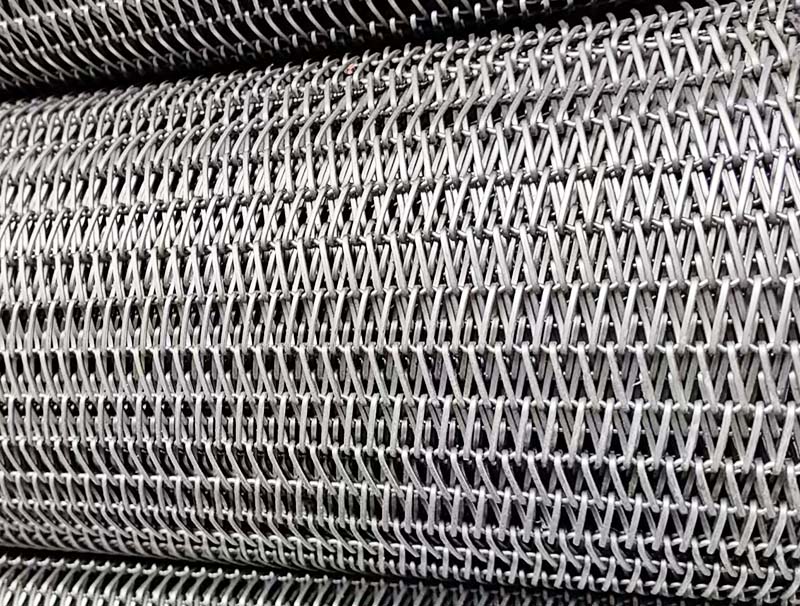
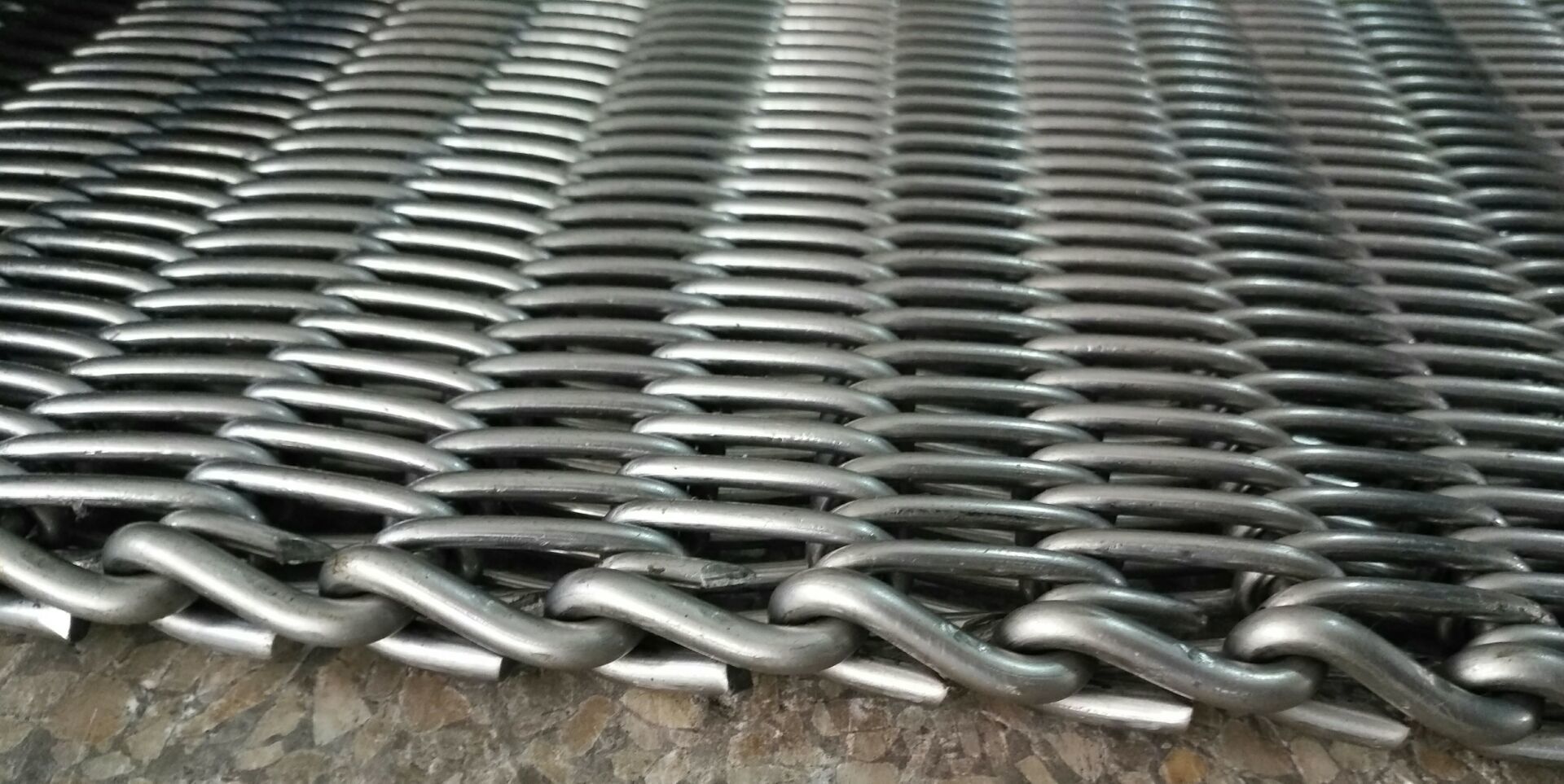
Due to its high strength, resistance to high and low temperatures, corrosion resistance, and ease of cleaning, the stainless steel mesh belt plays a critical role in "support and breathability" across various types of drying equipment. Different equipment has distinct requirements for the belts, leading to specialized applications as follows:
1. Mesh Belt Dryers – The Core Application Equipment
This is the most typical and widespread application for stainless steel mesh belts, especially for thin, heat-sensitive, and easily damaged materials (e.g., food, herbs, chemical pellets, wood veneer sheets). Key equipment includes:
Multi-layer Mesh Belt Dryers
Application: Continuous drying of food (fruit/vegetable chips, noodles, pet food), Chinese herbal medicine, feed, and organic fertilizer.
Belt Function: Multi-layer stacking maximizes vertical space utilization. The belt's permeability ensures hot air penetrates the material layers for uniform drying. Stainless steel (304/316) resists acids and alkalis, preventing material contamination (food-grade belts must meet FDA standards).
Selection Criteria: Wire diameter (e.g., 1.0mm-2.5mm) is chosen based on material thickness and weight. For multi-layer equipment, belt tension and anti-deviation correction are critical considerations.
Single-layer Mesh Belt Dryers
Application: Flat drying of large panels (e.g., plywood, fiberboard) and long materials (e.g., lumber, profiles).
Belt Function: When carrying heavy materials, a heavy-duty stainless steel mesh belt (e.g., woven type with reinforcing ribs) is required to withstand static/dynamic loads. Surface flatness directly impacts drying uniformity (e.g., panels require a flat surface to prevent water pooling in depressions).
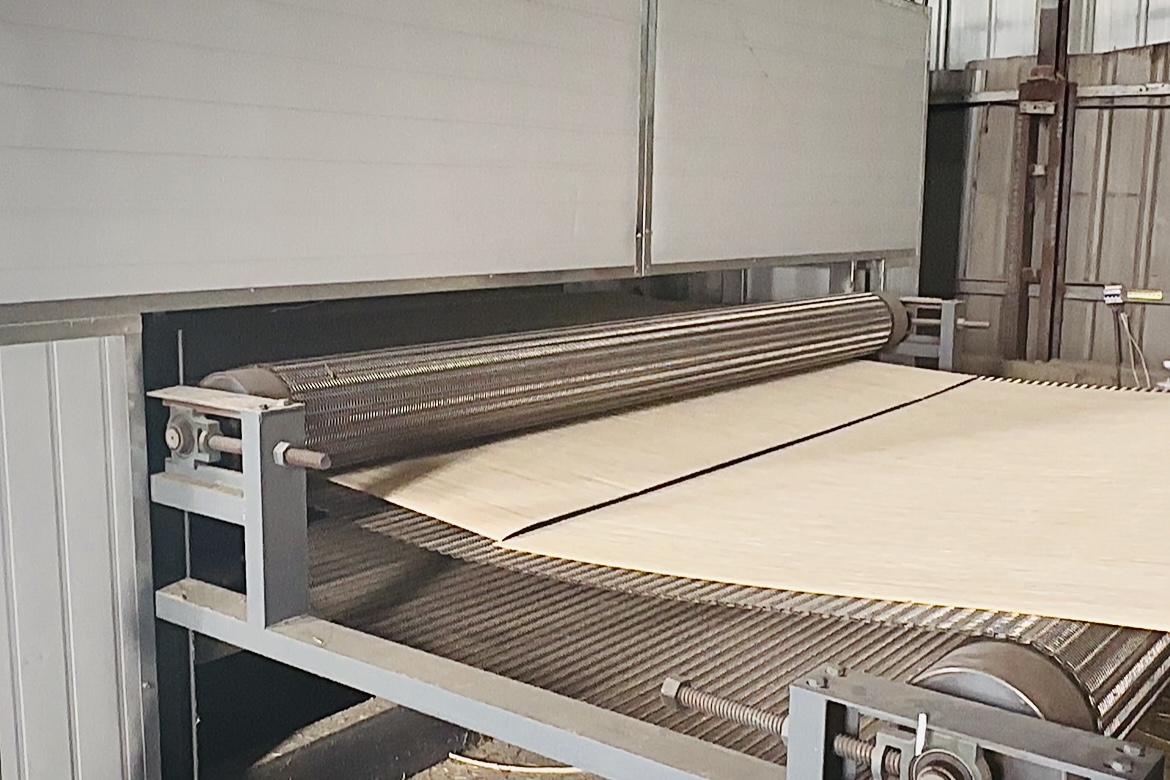
Specialized Mesh Belt Dryers for Veneer Sheets
Application: Drying of engineered wood veneer and natural veneer (ultra-thin, high-value).
Belt Function: A 304 stainless steel mesh belt (or PTFE-coated belt) provides zero-pressure contact, preventing scratches or dents on the veneer. Uniform mesh apertures ensure hot air penetration, maintaining the veneer's flatness and texture integrity (preventing warping and discoloration).
2. Belt Dryers – Integrated "Conveying + Drying" for Continuous Production Lines
Belt dryers are an extension of mesh belt dryers, emphasizing continuous production. They are common in:
Food Industry: Low-temperature drying of baked goods (biscuits, bread crumbs) and dehydrated vegetables (onion slices, carrot cubes).
Chemical Industry: Drying of pigments, catalysts, and plastic pellets, requiring belts resistant to chemical corrosion (e.g., 316L stainless steel for strong acids/bases).
Feature: Adjustable belt speed, combined with zoned temperature control (preheating, constant-rate drying, falling-rate drying), enables fully automated processing from infeed to discharge. The durability of stainless steel belts ensures stability for long-term continuous operation.
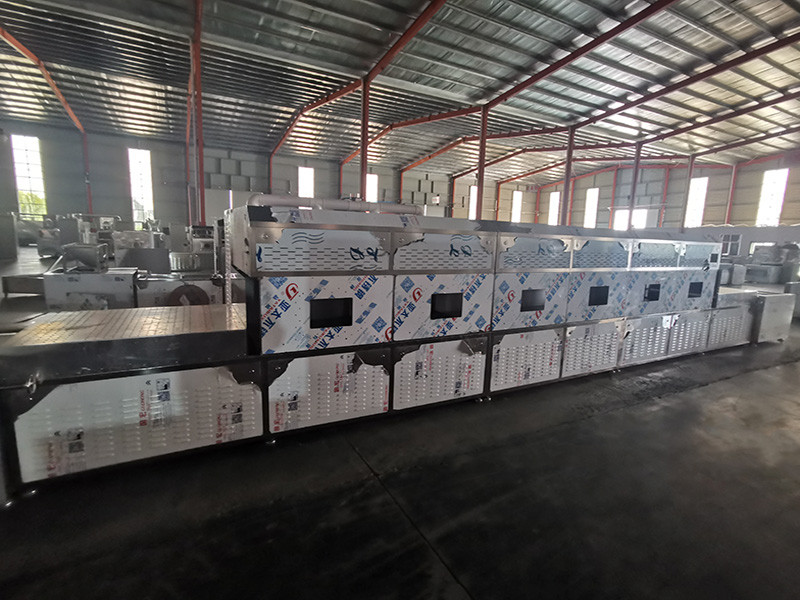
3. Tunnel Dryers – "Shuttle-style" Drying in Long, Enclosed Spaces
Tunnel dryers are typically cabinet structures with mesh belt conveyors, where materials travel through different temperature zones via the belt. Common applications include:
Building Materials Industry: Glaze drying for tiles and sanitary ceramics (requires belts that withstand high temperatures, e.g., 310S stainless steel for short-term exposure up to 1200°C).
Electronics Industry: Curing and drying of PCBs and electronic components (requires anti-static belts with no metal dust shedding; 304 stainless steel with electrolytic polishing meets this requirement).
Belt Function: Inside the sealed tunnel, the belt must withstand long-term high-temperature radiation and have a smooth surface for easy cleaning (to prevent cross-contamination between batches).
4. Vacuum Dryers – "Gentle Drying" in a Low-Pressure Environment
Vacuum dryers lower atmospheric pressure to reduce the boiling point of materials, enabling low-temperature drying (protecting heat-sensitive components). Considerations for stainless steel mesh belts here include:
Application: Pharmaceuticals (Chinese herbal extracts, antibiotics), biological products (enzyme preparations), and precision chemical materials.
Belt Requirements: Sealed stainless steel mesh belts (or special interfaces compatible with the vacuum chamber) are needed to prevent air leaks. The material must resist stress changes in a vacuum and not react with the product (e.g., 316L stainless steel resists chloride ion corrosion, making it suitable for the pharmaceutical industry).
5. Special Structure Dryers (Spiral/Flip-Flop) Drying"
Some dryers use combinations like spiral conveying + mesh belt or flip-flop plates + mesh belt (e.g., sludge dryers, mineral powder dryers):
Sludge Dryers: Belts carry high-moisture, sticky sludge and require a smooth surface to prevent sticking (opt for 304 stainless steel mirror-polished belts), often paired with a spiral agitator to prevent clumping.
Mineral Powder Dryers: Belts must be wear-resistant (e.g., high-manganese steel woven belts) to withstand abrasion from mineral particles, while their permeability ensures thorough contact between hot air and the powder.
6. Core Considerations for Selecting a Stainless Steel Mesh Belt
Material Properties:
Corrosiveness (e.g., 304/316 for food/pharma, 316L for chemicals).
Temperature (310S for high temps, standard 304 for low temps).
Weight (Heavy materials require thickened woven belts with support rollers).
Drying Process:
Permeability (open area must match hot air penetration needs; fine mesh for veneer, large-aperture for ore).
Flatness (High-precision materials like electronics require mirror-finish belts).
Equipment Compatibility:
Belt width/length must match the equipment's infeed dimensions.
Drive method (chain-driven/ must be compatible with the belt's edge structure (e.g., welded edges or rod-through edges).
The application of stainless steel mesh belts covers virtually all industries requiring continuous, uniform, and clean drying. Their core value lies in solving the problems of "contact contamination and uneven drying" inherent in traditional drum or tray dryers through "permeable conveying." The differentiated demands of various equipment essentially boil down to the precise matching of material weather resistance, structural strength, and surface characteristics—which is why stainless steel mesh belts have become the "standard configuration" for high-end drying equipment.
 RELATED
 RELATED
Copyright By © Shandong Shine Machinery Co.,Ltd
 ไทย
ไทย Indonesia
 Melayu
 Tiếng Việt
 Pусский
 Portugues
 Français
 Deutsch
 日本語
日本語 한국어
한국어 العربية
 Italiano
 Polski
 Nederlands
 Türk dili
 हिन्दी
 Ελληνικά
 Svenska
 Español