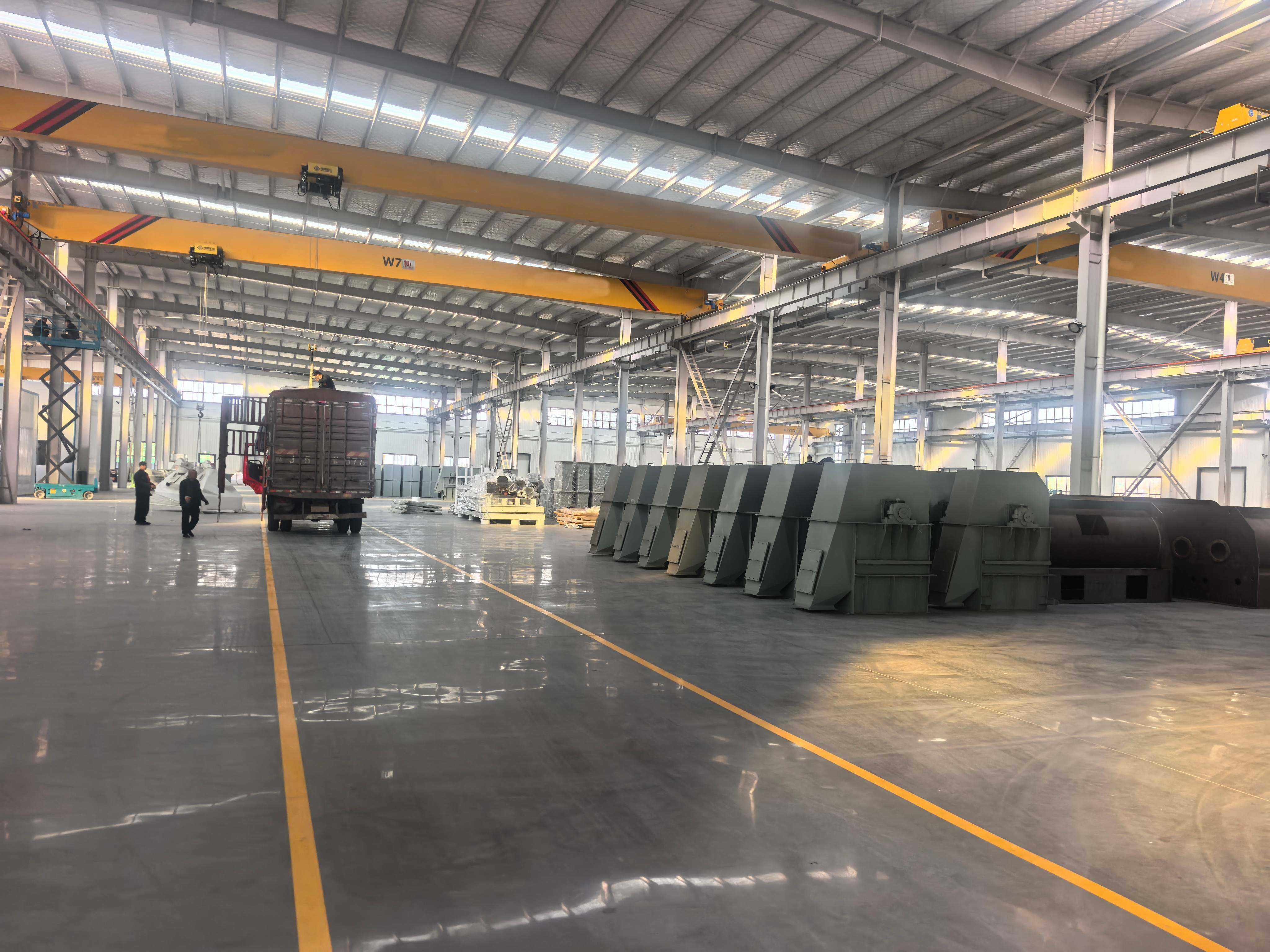
Product Introduction
The Automatic Gypsum Mortar Production Line is a fully integrated dry-mix manufacturing system engineered to convert gypsum binder, aggregates, and functional additives into consistent, ready-to-use mortar with minimal manual intervention. Unlike semi-automatic configurations that require operator involvement at batching, mixing, or packaging stages, this line executes the entire production sequence — from silo discharge and precision weighing through gravity-free mixing, valve-bag packaging, and robotic palletizing — under a centralized control architecture.
The distinction matters in operational terms. A fully automatic gypsum mortar line is designed so that all raw materials, including additives, are automatically metered, conveyed, mixed, packaged, transported, and palletized, with the entire production process operating without manual participation. For manufacturers targeting the plastering gypsum, self-leveling underlayment, and joint compound segments, this level of automation translates directly into batch-to-batch consistency, reduced labor dependency, and the throughput stability required to serve regional distribution networks and large-scale construction projects.-20
Product Features
1. End-to-End PLC-Governed Automation
The defining characteristic of this production line is the centralized PLC control system that coordinates every subsystem as a single synchronized workflow. Industrial configurations typically deploy Siemens PLC platforms with color HMI interfaces, integrating batching, mixing, packaging, and palletizing under one control logic. The control system supports recipe management with one-key switching, enabling changeover between lightweight plastering gypsum, heavy plaster, self-leveling mortar, and joint compound without extended recalibration. Real-time production monitoring and data logging provide traceability from raw material intake through finished pallet, and multi-language interfaces accommodate export-oriented operations.-32-34
2. Robotic Palletizing for Labor-Independent Dispatch
Where semi-automatic lines still depend on manual bag handling at the end of the process, the automatic configuration closes the loop with six-axis robotic palletizing systems capable of handling 1,000 bags per hour with repeatable pattern precision. Higher-capacity robotic units can stack up to 800 bags per hour on a continuous 24-hour basis, with integrated film wrapping and production data synchronization. This automation stage eliminates the ergonomic burden of manual stacking while ensuring pallet stability for transport and storage — a factor that directly affects product integrity upon delivery.-32-41
3. High-Precision Batching Down to Micro-Additive Level
Automation without metering precision merely accelerates error. The line addresses this with a multi-tier weighing architecture: main gypsum and aggregate scales operate with accuracy in the range of ≤ ±0.3% on standard configurations, with high-specification systems achieving ±0.15% batching accuracy. Dedicated micro-additive weighing scales manage retarders, water-retention agents, and other low-dosage components at accuracies down to ±0.1%, and in premium configurations ±0.05%. This tiered precision is essential for gypsum mortars, where small variations in retarder dosage can shift setting time and workability in ways that are difficult to correct downstream.-10-34
4. Gravity-Free Mixing Preserving Aggregate Integrity
Gypsum mortar formulations—particularly lightweight plastering gypsum—frequently contain fragile aggregates such as expanded perlite or glazed hollow beads. The production line employs a twin-shaft gravity-free paddle mixer that generates three-dimensional convection and diffusion under low mechanical stress. Industry-leading configurations achieve mixing uniformity ≥ 99.6% with batch cycles of 3 to 5 minutes, maintaining output continuity without compromising the structural integrity of lightweight constituents. For heavy plaster and self-leveling formulations, the same mixing platform delivers the shear and dispersion required for homogeneous additive distribution across higher-density batches.-10
5. Closed-Loop Dust Containment
Gypsum powder is fine, airborne, and persistent. The automatic line operates under fully enclosed negative pressure, with pulse-jet bag dust collectors deployed across silo tops, transfer points, mixing zones, and packaging stations. The design philosophy is dual: point-source collection at high-dust-concentration areas and overall recovery in surrounding zones, creating a standardized workshop environment. Enclosed conveying—screw conveyors, bucket elevators, and sealed pneumatic lines—prevents material escape throughout the flow path, reducing both environmental emissions and product loss.-20
6. Configurable Capacity for Distinct Market Positions
The line spans a wide operational envelope. Standard production capacities range from 3 to 30 tons per hour for self-leveling and lightweight plaster configurations, with broader platforms reaching 5 to 50 tons per hour and 15 to 150 tons per hour on large-scale industrial designs. Annual output can reach 300,000 tons per production line, supporting both regional entry strategies and national-scale supply. Compact fully automatic skid-mounted designs at the lower capacity boundary (3–5 t/h) allow smaller manufacturers to access automation without the capital commitment of a tower plant, while tower-layout systems serve high-throughput export operations.-10-20-
7. Seamless Integration with Upstream and Downstream Systems
The automatic line is designed as a node within a larger production ecosystem. It can be directly coupled to an upstream gypsum calcination line, with calcined powder conveyed pneumatically into storage silos — eliminating intermediate bagging and re-handling. Downstream, the packaging module accommodates valve bags, ton bags, and bulk discharge configurations, with automatic bag placing, sealing, and conveying available as extensions. This integration capability reduces total plant footprint and operational complexity while maintaining continuous material flow from raw gypsum to palletized finished product.
Product Applications
The Automatic Gypsum Mortar Production Line is engineered around the formulation and processing requirements of gypsum-based dry-mix mortars. Its automation architecture is particularly suited to applications where product consistency and throughput stability are commercially decisive.
Lightweight Plastering Gypsum. The gravity-free mixing action and anti-segregation discharge design preserve the integrity of expanded perlite and glazed hollow beads, ensuring the finished mortar delivers its specified yield and thermal performance. Automated recipe management allows rapid switching between density grades without cross-batch contamination.
Gypsum Self-Leveling Mortar. Self-leveling compounds demand strict control over particle distribution, flow behavior, and additive dispersion. The high-accuracy micro-additive weighing and homogeneous mixing achieved by the line provide the reproducibility required for floor underlayment applications, where batch-to-batch flow variation is unacceptable.
Gypsum Board Joint Compound. The line is compatible with joint compound production for drywall finishing. Automated batching and mixing consistency provide a reliable process foundation for meeting product-quality expectations under standards such as JC/T 2075-2011, which specifies performance requirements for gypsum-based caulking materials used in gypsum board construction. Robotic palletizing further supports the high-volume dispatch patterns typical of joint compound supply chains.
Heavy Plaster and Gypsum-Based Putty. For denser formulations, the line maintains batching precision and mixing uniformity across higher-bulk-density recipes, supporting consistent setting behavior and compressive strength development. The same automated platform can produce gypsum-based adhesives, wall putty, and specialty mortars, allowing manufacturers to utilize a single capital asset across multiple product categories.
Across these applications, the common value proposition is operational predictability: the automatic line reduces the variables introduced by human intervention at weighing, mixing, and packaging stages, converting raw material inputs into finished pallets with a repeatability that semi-automatic configurations cannot match.
Copyright By © Shandong Shine Machinery Co.,Ltd
 ไทย
 Indonesia
 Melayu
 Tiếng Việt
 Pусский
 Portugues
 Français
 Deutsch
 日本語
 한국어
 العربية
 Italiano
 Polski
 Nederlands
 Türk dili
 हिन्दी
 Ελληνικά
 Svenska
 Español