In plywood veneer drying, moisture control is not just a number on a datasheet—it is a practical inspection discipline that connects incoming veneer conditions, dryer settings, and outfeed acceptance. When fresh veneer enters a veneer dryer machine at 60–80% initial moisture content, the goal is to reduce moisture to a level suitable for downstream processing while protecting veneer flatness and surface quality.
In many factories, the most useful way to manage that target is to treat 8–12% final moisture content as an outfeed sampling inspection rule, not as an unconditional promise for every single sheet. This approach aligns daily quality control with how a Veneer Drying System runs in real production—where veneer thickness, incoming moisture variation, and operating adjustments can influence sheet-by-sheet readings.

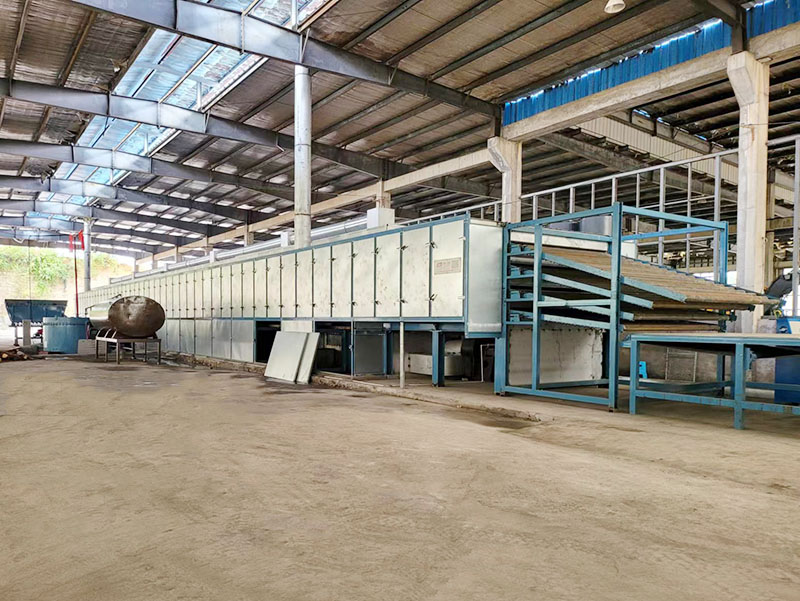
A veneer dryer machine removes moisture through controlled heating and continuous conveying. For plywood veneer drying, the practical outputs that buyers focus on are straightforward: stable drying efficiency, a final moisture window suitable for gluing, and veneer condition after drying.
For example, the Shine-20 Mesh Belt Veneer Dryer is specified for an initial moisture content of 60–80% and a final moisture content of 8–12%, with a drying temperature of 150–180℃. The machine is configured as a mesh belt veneer dryer for continuous drying operations.
| Item | Specification |
|---|---|
| Model | Shine-20 |
| Working width | 3000 mm |
| Layers | 2 deck |
| Veneer thickness | 0.2–4 mm |
| Initial moisture content | 60–80% |
| Final moisture content | 8–12% |
| Drying temperature | 150–180℃ |
| Heating section | 18,000 mm |
| Cooling section | 2,000 mm |
| Veneer feeding section | 1,500 mm |
| Veneer discharge section | 1,500 mm |
| Heating medium | Steam or thermal oil |
| Drying capacity | 1–1.5 m³/h |
| Total power | 47 kW |
| Overall dimension | L 23 m × W 4.36 m × H 2.2 m |
| Container | 1×40’HQ + 1×20’HQ |
These parameters are useful when setting up a Veneer Drying System because they clarify the operating envelope for drying veneer from 60–80% to an outfeed range that can be checked through inspection.
In plywood veneer drying, there is a difference between:
a veneer dryer machine’s specified final moisture content range, and
the moisture content that will be measured on each individual veneer sheet at the outfeed.
Even within the same Veneer Drying System, veneer sheets may differ in thickness, incoming moisture distribution, and other production conditions. As a result, interpreting 8–12% as a sheet-by-sheet guarantee can create avoidable disputes inside a factory: the dryer is judged by exceptional single readings instead of by the sampling outcomes that reflect stable operation.
A more workable interpretation is to use 8–12% as a sampling inspection window. That makes the veneer dryer machine specification actionable: the line is evaluated by representative outfeed checks, and the factory can decide how to respond when readings trend high or low.
This is also consistent with the way many buyers evaluate plywood veneer drying equipment—by looking at whether the Veneer Drying System can be operated repeatably and inspected consistently, rather than expecting identical moisture in every sheet.
A sampling rule only works if it is simple enough to follow on the shop floor. The procedure below turns “8–12%” into an inspection habit that supports both quality management and production continuity.

Confirm incoming veneer conditions before drying: initial moisture content, veneer thickness, and the lot identity used in production records.
Record operating settings during plywood veneer drying: the running temperature and the conveying conditions used in that production run.
Collect outfeed samples as veneer exits the Veneer Drying System. Samples should represent the batch rather than only the best-looking sheets.
Measure and log readings using the factory’s chosen method, keeping individual values rather than only an average.
Judge results against the sampling rule: treat 8–12% as the inspection window and evaluate distribution.
Adjust and re-check if sampling drifts outside the approved window: review incoming conditions and the running parameters before making changes.
This sampling inspection discipline is especially valuable in continuous plywood veneer drying, because it supports fast decisions without interrupting the full Veneer Drying System every time a single sheet reads unusually high or low.
Not every Veneer Drying System is built around the same product goal. Some lines prioritize veneer surface condition and flatness for face veneer; others prioritize throughput and installation footprint for core veneer. That is why procurement teams often compare multiple configurations—such as a Vertical Veneer Dryer for compact installation and a Low Cost Veneer Dryer for continuous roller conveying.
A Vertical Veneer Dryer is described as using three-dimensional loading of veneer and covering only about two-thirds of the area of a roller dryer. In the listed parameters for model FBH30-13, moisture content is specified as fresh veneer dried to 0–5%, and the listed output is 2 m³/h.
A separate vertical model, FBH30-20, lists moisture content as fresh veneer to within 20% and a capacity of 1.2–1.5 m³/h.
These published parameters highlight an important procurement point: the 8–12% sampling rule is tied to the specific veneer dryer machine configuration being used. A Vertical Veneer Dryer can be evaluated with a moisture sampling rule too—but the factory should align the inspection window with the vertical model’s stated moisture objective.
For buyers considering a roller-based Veneer Drying System, the Low Cost Veneer Dryer Machine is presented as a roller veneer dryer type with 3 m working width, 0.8–8 mm veneer thickness, 32 m heating area length, and a listed drying capacity of 50–60 m³/day. The heat source is listed as a biomass burner (other options available).
For core veneer production, factories often also evaluate a roller solution such as the roller veneer dryer, which is described as adopting frequency conversion and automatic control functions to adjust transmission speed and temperature.
Across these choices, the same management concept applies: plywood veneer drying performance should be judged through a clear moisture sampling inspection rule matched to the equipment and product requirement.
A Veneer Drying System becomes easier to control when production records connect the three things that most affect moisture inspection: incoming veneer, dryer settings, and outfeed sampling results.
Incoming range check: For Shine-20, match production batches to the 60–80% initial moisture content assumption used in its specification.
Temperature discipline: For Shine-20, operate within the specified 150–180℃ temperature range and record any intentional changes.
Section awareness: Shine-20 is structured around a heating section and a cooling section, with defined feeding and discharge sections. This supports consistent outfeed sampling after cooling.
Automation and stability: Shine-20 is described as being equipped with an automatic control system, with merits including saving labor costs, high drying efficiency, easy operation, and low failure rate.
When the sampling inspection rule shows drift outside 8–12% for the Shine-20 specification, the response should start with record review: confirm the batch’s incoming conditions, then check the running settings used in that shift.
Buyers comparing a veneer dryer machine typically verify not only the technical parameters but also the practical support process around installation and operation.
Pre-sale consultation and planning for veneer production line selection
Machine inspection before leaving the factory
Overseas install and debug support
Training for first-line operators
After-sale support such as 24-hour online service, installation and debug video support, and technical exchanging by phone
These checks help purchasers align the Veneer Drying System with their plant conditions and confirm that moisture inspection rules can be implemented consistently after commissioning.
In plywood veneer drying, the most reliable moisture target is one that can be inspected and managed in daily production. For veneer entering at 60–80% initial moisture content, the Shine-20 specification of 8–12% final moisture content is best applied as an outfeed sampling inspection rule, not as a requirement that every single sheet must match perfectly.
Used this way, a veneer dryer machine specification becomes an operational tool: it supports clear acceptance criteria, disciplined recordkeeping, and faster troubleshooting—without turning normal sheet-to-sheet variation into a production stoppage.
No. In plywood veneer drying, 8–12% is best applied as an outfeed sampling inspection rule for the batch, rather than a sheet-by-sheet guarantee.
The Shine-20 is specified for 60–80% initial moisture content.
The Shine-20 lists 8–12% final moisture content.
The Shine-20 is specified for 150–180℃ drying temperature.
The Shine-20 lists a drying thickness range of 0.2–4 mm.
A Vertical Veneer Dryer can also be managed using sampling inspection, but the inspection window should match the selected vertical model’s stated moisture objective.
It is listed as a roller veneer dryer type with 3 m working width, 0.8–8 mm veneer thickness, 32 m heating area length, and 50–60 m³/day drying capacity.
Copyright By © Shandong Shine Machinery Co.,Ltd
 ไทย
 Indonesia
 Melayu
 Tiếng Việt
 Pусский
 Portugues
 Français
 Deutsch
 日本語
 한국어
 العربية
 Italiano
 Polski
 Nederlands
 Türk dili
 हिन्दी
 Ελληνικά
 Svenska
 Español



