Replacing a traditional roller dryer can free up valuable production space, but only if the full veneer dryer machine layout is planned realistically. In many plywood veneer drying projects, buyers focus on the equipment footprint first—then discover late in the process that maintenance access, feeding and discharging zones, and fan and burner service clearance still drive the final workshop arrangement.
Shine Machinery’s Vertical Veneer Dryer is positioned as a compact option because its three-dimensional loading structure allows the equipment body to cover only two-thirds of the area of a roller dryer. The key takeaway for layout planning is simple: footprint savings are real, but service aisles must be calculated separately.

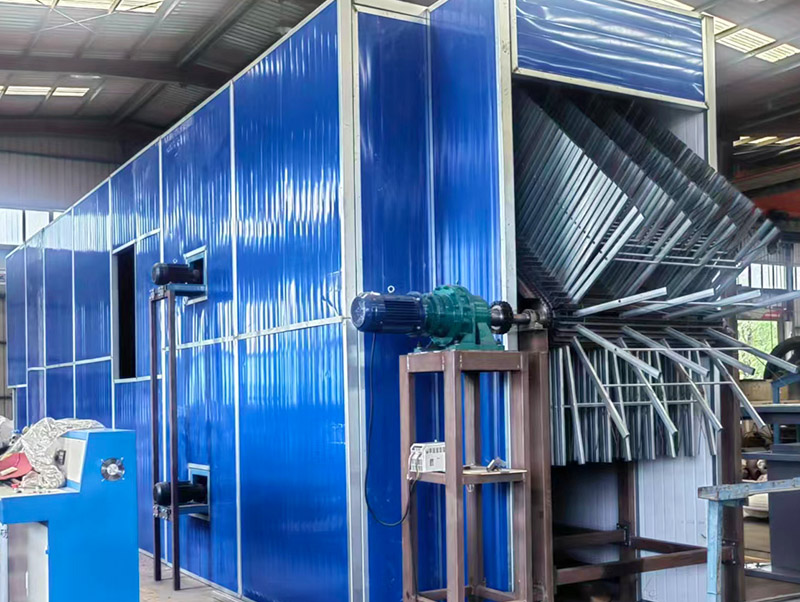
In a veneer drying workshop, equipment footprint is only the floor area occupied by the dryer body. A workable Veneer Drying System also needs space for people, forklifts or carts (where applicable), and routine service tasks.
A practical veneer dryer machine layout therefore separates two calculations:
Dryer body footprint (the machine’s external length × width)
Allocated installation area (footprint plus access and operating zones)
For example, even if a Vertical Veneer Dryer reduces the dryer body footprint, you may still need similar access space around key components to support daily operation and maintenance. This is why experienced planners treat aisles and service clearance as their own line item, instead of scaling them down by the same percentage as the machine footprint.
A simple planning relationship that stays realistic is:
Allocated installation area = Dryer body footprint + (feeding/discharging zones) + (maintenance and service access)

This approach helps prevent the most common layout mistake: assuming “two-thirds footprint” automatically means “two-thirds total space.”
Shine Machinery describes its Vertical Veneer Dryer as using three-dimensional loading of veneer, which is the structural reason it can reduce the equipment footprint. In the same product description set, Shine Machinery also notes that the vertical system uses a chain to bring veneer or finished board into the drying room for circulating drying.
When buyers compare a Vertical Veneer Dryer with a roller dryer, the most useful “first-pass” comparison is:
Vertical layout focus: three-dimensional loading and compact equipment body
Roller layout focus: roller conveying structure and typical long-chamber form factor
Just as important, Shine Machinery emphasizes airflow behavior for the vertical system: uniform airflow, uniform temperature, and a countercurrent drying cycle designed to support fast drying and uniform quality.
To keep decisions grounded during early-stage layout work, treat the “two-thirds” statement as a machine-body footprint comparison, then develop the full veneer dryer machine layout around the actual workshop route and service plan.
A veneer dryer machine layout that “looks compact” on paper can become hard to operate if access is not planned around the parts that must be inspected, adjusted, or serviced.
Shine Machinery’s published parameter lists and product descriptions reference typical working components and zones that layout teams usually plan around, such as hot air fans, traction motors, induced draft fans, and burner-related equipment.
For layout purposes, the most common space reservations are:
Feeding area: room for steady veneer loading and staging
Discharging area: space to receive dried veneer and keep flow moving
Fan and airflow service access: clearance to reach fan sections for routine inspection
Drive and conveying access: clearance around traction and conveying sections
Heating-related access: space to reach heat-source-related components
Shine Machinery also describes the vertical tunnel-type core veneer dryer as being composed of four parts: Feeding area, Heating area, Cooling area, and Discharging area. Even when the equipment body is compact, these functional areas still influence how people and materials move around the Veneer Drying System.
The practical rule that layout teams rely on is unchanged by footprint reductions:
Do not reduce maintenance aisles by percentage—reserve access by task and component location.
In Shine Machinery’s product information, the drying cost of the vertical dryer is stated as less than $8/M³, described as 30–60% of the drying cost of other dryers. In layout terms, lower operating cost goals often increase the importance of keeping material handling smooth—because bottlenecks outside the dryer can reduce the benefit of efficient drying.
Shine Machinery also states that the vertical plywood method increases the loading capacity of the veneer, described as 30–80% higher than that of other dryers. From a layout perspective, higher loading capacity can place more pressure on feeding and discharging organization. Even when the dryer body is smaller, you may want more orderly staging space at the ends to keep continuous work stable.
For Drying Veneer quality consistency, Shine Machinery describes the vertical system as adopting a countercurrent drying cycle, with uniform airflow and steady temperature. That performance target reinforces the need for a layout that supports stable operation and easy access for routine checks.
To explore the equipment category referenced here, buyers typically start from a product overview such as the vertical veneer dryer series.
A practical way to keep a veneer dryer machine layout realistic is to anchor early drafts on published external dimensions and utility-related parameters.
Shine Machinery publishes model parameters for vertical configurations, including the following examples.
Model: FBH30-13
Moisture content (%): fresh veneer dried to 0–5%
Output (m³/h): 2
Machine size (m): 13 × 3 × 4
Total power (kW): 15
Fuel consumption (KG/H): 200
These parameters are part of Shine Machinery’s description of Wood Vertical Veneer Drying.
Model: FBH30-20
Moisture content (%): fresh veneer to within 20%
Capacity (m³/h): 1.2–1.5
Overall size: 20 × 7 × 4
Total power (kW): 36.3
Labor (workers): 3
This example is presented under the Vertical Plywood Veneer configuration. Both the dimensions and the moisture targets matter for planning a plywood veneer drying line, because they affect how much end space you reserve for feeding, discharging, and material routing.
One more layout-critical detail in Shine Machinery’s product information is installation method: the vertical equipment is described as needing to be assembled on the customer’s factory site, enabling installation according to specific location requirements. That makes it especially important to confirm the final veneer dryer machine layout before civil work is locked.
When a project goal is “save floor space,” use a checklist that keeps the Veneer Drying System maintainable over its full service life:
Confirm workshop length, width, and height, then match them to the selected dryer’s external dimensions.
Reserve clear feeding and discharging areas aligned with your material flow.
Identify where hot air fans, traction motors, and induced draft fans will be accessed.
Treat the heating area and its related access as a fixed requirement, not leftover space.
Keep service aisles independent of footprint math—plan clearance by maintenance task.
If you are comparing suppliers under search terms like “China veneer dryer manufacturer” or “China veneer dryer supplier,” request a layout discussion using your shop drawing and target output.
For buyers comparing vertical and roller configurations, reviewing both a Vertical Core Veneer Dryer Machine and a reference roller configuration such as a Roller Core Veneer Drying Machine helps keep the footprint conversation connected to the real workshop route.
Shine Machinery states that its vertical core veneer dryer equipment covers only two-thirds of the area of the roller dryer. This is presented as an equipment-body footprint comparison.
Not necessarily. A veneer dryer machine layout should reserve maintenance access based on the service tasks and component locations, not as a percentage of dryer footprint.
Shine Machinery describes uniform airflow, uniform temperature, and a countercurrent drying cycle intended to support fast drying and uniform quality.
Shine Machinery states the drying cost of the vertical dryer is less than $8/M³, described as 30–60% of the drying cost of other dryers.
Shine Machinery states the vertical plywood method increases veneer loading capacity by 30–80% compared with other dryers.
Yes. Shine Machinery states the equipment needs to be assembled on the customer’s factory site, allowing installation according to specific location requirements.
Shine Machinery describes four parts: Feeding area, Heating area, Cooling area, and Discharging area.
Copyright By © Shandong Shine Machinery Co.,Ltd
 ไทย
ไทย Indonesia
 Melayu
 Tiếng Việt
 Pусский
 Portugues
 Français
 Deutsch
 日本語
日本語 한국어
한국어 العربية
 Italiano
 Polski
 Nederlands
 Türk dili
 हिन्दी
 Ελληνικά
 Svenska
 Español


