Switching to a cutting-first-then-drying flow for thick core veneer changes how you should size a veneer dryer machine. Length is still important, but it is rarely the starting point. The practical approach is to define your output target and moisture requirement first, then select a dryer structure and configuration that can realistically deliver that target within your available workshop footprint.
Shine Machinery positions its Vertical Veneer Dryer as suitable for “cutting first and then drying,” especially for thick veneers, and also notes that dryer length should be determined according to the required output. That idea—start from production, then determine length—is the most reliable way to avoid an oversized machine that wastes space or an undersized line that becomes a bottleneck.

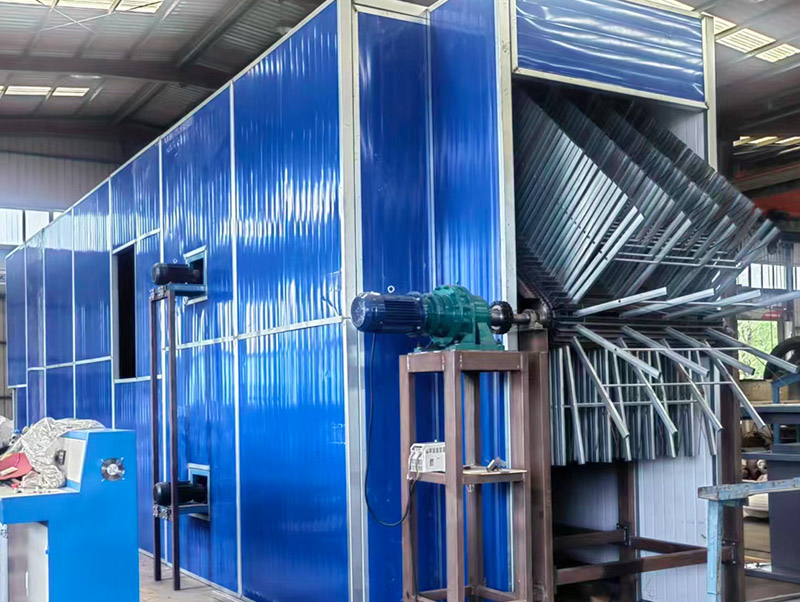
In plywood veneer drying, thick core sheets typically push mills to pay closer attention to residence time, loading method, and airflow stability. In practice, the dryer’s internal design can matter as much as the external length.
Shine Machinery describes its Vertical Veneer Drying Machine as a main equipment option for plywood production, built around four sections—Feeding area, Heating area, Cooling area, and Discharging area—and aimed mainly at drying core plate, partial surface, and bottom plate. The same documentation highlights two decision points that are especially relevant when Drying Veneer after cutting:
The equipment “is suitable for veneers with low flatness requirements.”
The dryer “length needs to be determined according to your output,” and it can be designed per project requirements.
For buyers planning a Veneer Drying System for thick core production, that is a direct signal: you should not treat dryer length as a fixed spec you “pick off the shelf.”
A common purchasing mistake is comparing only the advertised length of different machines. Vertical dryers are often evaluated for their loading method and floor-space efficiency, not only for length.
Shine Machinery notes that vertical core veneer dryer equipment uses three-dimensional loading and covers an area of only two-thirds of the roller dryer footprint. It also states three performance-oriented points buyers typically care about when building a cutting-first-then-drying line:
Drying output is high because the vertical plywood method increases loading capacity by 30–80% compared with other dryers.
Drying cost is low, stated as less than $8/m³, described as 30–60% of the drying cost of other dryers.
The vertical equipment “needs to be assembled on the customer’s factory site,” allowing installation to match the actual location constraints.
If your workshop space is tight, these footprint and loading characteristics can be just as decisive as the nominal dryer length.

Start with the throughput your line must sustain. Shine Machinery’s vertical models illustrate why this matters. For example, the FBH30-13 is listed at 2 m³/h, while the FBH30-20 is listed at 1.2–1.5 m³/h—even though the second machine is longer. That single comparison is often enough to prevent a costly mistake: a longer veneer dryer machine is not automatically a higher-capacity line.
Moisture targets affect how aggressively you must dry, which can affect configuration and capacity. Shine Machinery’s vertical core veneer model parameters include targets such as:
FBH30-13: fresh veneer dried to 0–5% moisture content.
FBH30-20: fresh veneer to within 20% moisture content.
These are not interchangeable requirements. When two buyers request different final moisture content, it is normal for the “right” machine length and configuration to differ.
Thick veneer work is often discussed alongside roller dryers as well. Shine Machinery’s Core Veneer Drying Machine model GTH30-20 specifies a veneer thickness range of 0.6–8 mm, and a final moisture guideline of about 8–10% for fresh veneer.
Even if your project leans toward a Vertical Veneer Dryer, using a published roller reference like GTH30-20 helps buyers sanity-check whether the target thickness range and output expectations are realistic for their intended plywood veneer drying conditions.
If you decide to evaluate a vertical layout primarily to save installation area, treat the available footprint as a “hard boundary” in your design discussion. Shine Machinery’s vertical dryer documentation explicitly frames the equipment as covering only two-thirds of the area of a comparable roller dryer and being assembled on-site, which helps projects adapt to real building constraints.
The table below consolidates key published parameters from Shine Machinery pages. It is meant as a reference for procurement discussions, not as a one-size-fits-all sizing rule.
FBH30-13 | Vertical | Machine size 13×3×4 m | 2 m³/h | 0–5% |
FBH30-20 | Vertical | Overall size 20×7×4 m | 1.2–1.5 m³/h | within 20% |
GTH30-20 | Roller (4 deck) | Heating area 16 m, cooling area 4 m | 2.5 m³/h | about 8–10% |
When buyers read these side by side, the sizing takeaway is straightforward: capacity and moisture requirement can change the “right” length—even within the same supplier’s lineup.
Even when a project is centered on a Vertical Veneer Dryer, many procurement teams still compare against roller options because roller dryers are a common benchmark in Veneer Drying System planning.
Shine Machinery’s GTH30-20 (Core Veneer Drying Machine) includes operational parameters that can help frame discussions with engineering and operations teams:
Heating material and temperature: waste wood, 140–200°C adjustable
Temperature control accuracy: ±5°C
Veneer transport speed: 5–22 m/min
Actual electricity consumption: about 100 kWh per hour
Separately, Shine Machinery describes a Roller Core Veneer Dryer Machine as delivering uniform moisture content with flat veneer “without buckle or end waviness,” and states that the veneer after drying is free of splits and in good condition for gluing. It also describes an automatic control system designed to save labor cost with easy operation and low failure rate, and notes frequency conversion to adjust transmission speed and temperature.
For cost-focused evaluations, Shine Machinery also presents a Low Cost Veneer Dryer Machine (roller type) with working width 3 m, veneer thickness 0.8–8 mm, heating area length 32 m, and drying capacity 50–60 m³/day, using a biomass burner heat source (with other options noted on the page).
These roller references do not replace vertical sizing—but they help buyers benchmark what “capacity-focused” specifications look like when comparing multiple layouts.
Before you finalize a target veneer dryer machine length, procurement teams typically confirm the items below with production and facility teams:
Target output (m³/h or m³/day) and whether the dryer must match upstream cutting speed.
Thickness range to be processed (for example, Shine Machinery lists 0.6–8 mm for GTH30-20, and 0.8–8 mm for its low cost roller page).
Final moisture requirement that your downstream process requires (examples in Shine Machinery vertical models range from 0–5% to within 20%).
Available footprint and installation constraints, especially if you are considering three-dimensional loading and on-site assembly.
Preferred dryer structure: vertical vs. roller, based on space, labor arrangement, and the flatness requirement described for the vertical tunnel-type design.
If you are comparing Shine Machinery’s vertical lineup, start with published models such as Wood Vertical Veneer Drying (FBH30-13) and Vertical Plywood Veneer (FBH30-20), then work backward from your required output to a suitable length and configuration.
For thick core veneer running a cutting-first-then-drying process, the most dependable sizing logic is consistent across projects: define output and moisture targets, confirm thickness range and footprint constraints, then determine the appropriate dryer length and layout.
Shine Machinery states that vertical dryer length is determined by required output and that equipment can be designed per project requirements. Buyers planning a new line can review the published specifications on www.veneersdryer.com and use those parameters as a structured basis for comparing configurations.
Shine Machinery describes its vertical tunnel-type core veneer dryer as suitable for the production process of cutting first and then drying, especially for drying thick veneers.
Not necessarily. Shine Machinery’s vertical model references include FBH30-13 at 13×3×4 m with 2 m³/h, and FBH30-20 at 20×7×4 m with 1.2–1.5 m³/h. Capacity needs to be evaluated together with configuration and moisture targets.
Shine Machinery lists FBH30-13 as drying fresh veneer to 0–5%, and FBH30-20 as drying fresh veneer to within 20%.
The Core Veneer Drying Machine (GTH30-20) lists a veneer thickness range of 0.6–8 mm.
Shine Machinery lists a 16 m heating area length and a 4 m cooling area length for GTH30-20.
Shine Machinery states that vertical core veneer dryer equipment covers an area of only two-thirds of the roller dryer, and uses three-dimensional loading.
Copyright By © Shandong Shine Machinery Co.,Ltd
 ไทย
 Indonesia
 Melayu
 Tiếng Việt
 Pусский
 Portugues
 Français
 Deutsch
 日本語
 한국어
 العربية
 Italiano
 Polski
 Nederlands
 Türk dili
 हिन्दी
 Ελληνικά
 Svenska
 Español



