Learn how airflow, temperature, and a countercurrent drying cycle influence veneer dryer machine speed, moisture uniformity, and buyer selection.

Achieving fast output in a plywood line is only truly beneficial if the Drying Veneer consistently meets moisture targets and maintains stable sheet conditions for subsequent gluing. Often, buyers err by viewing “speed” as the sole factor, overlooking how crucial elements like airflow direction, temperature stability, and dwell time interact within a Veneer Drying System.
This is precisely why the countercurrent drying cycle warrants scrutiny. Shine Machinery's description for its wood vertical veneer drying highlights this process, characterized by uniform airflow, steady temperature, and a countercurrent drying cycle. These elements work in concert to “ensure that the wood chips are dried quickly and the quality is uniform.” Neglecting the countercurrent aspect during evaluation or operation can lead to impressive throughput figures on paper, yet compromise the fundamental mechanism designed to maintain consistent drying quality.

In a typical plywood veneer drying conversation, teams often prioritize heater size or line speed. However, Shine Machinery’s vertical approach frames performance differently: the dryer’s circulation arrangement (countercurrent) is considered alongside airflow uniformity and temperature stability. Simply put, the countercurrent drying cycle isn't an optional add-on; it's fundamental to the operational logic that ensures both quick drying and uniform quality.
For procurement teams, the takeaway is clear: when evaluating a veneer dryer machine, the crucial inquiry extends beyond “How fast can it run?” to “How does the machine’s process description detail its method for sustaining uniform conditions at that speed?” If the published process highlights countercurrent circulation, excluding this element from the decision-making process risks rendering speed comparisons deceptive.
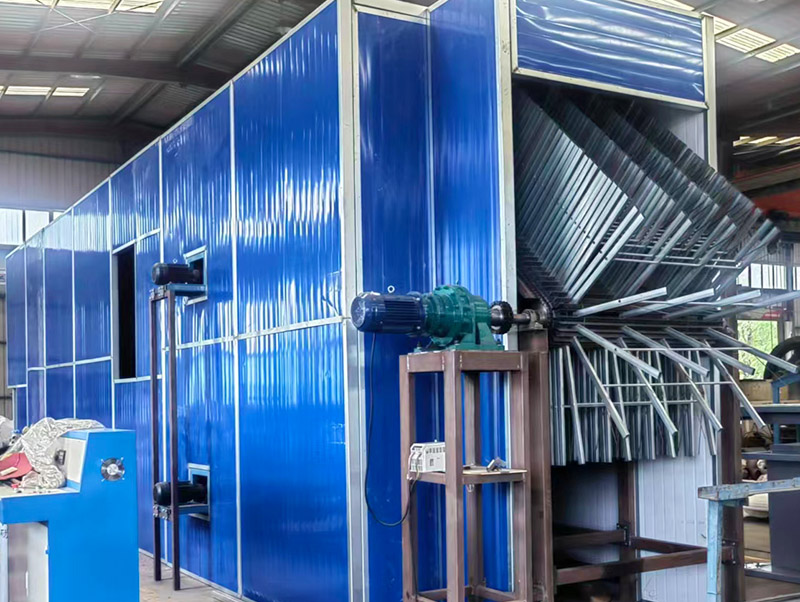
Shine Machinery presents its vertical design as a primary equipment choice for plywood production, structured into four distinct areas: Feeding, Heating, Cooling, and Discharging. This vertical tunnel-type core veneer dryer is primarily for drying core plate, partial surface, and bottom plate. It's engineered specifically for core veneer, offering lower costs and requiring minimal specialized worker training.
Several practical advantages are notable:
The equipment “covers a small area,” using three-dimensional loading of veneer, and is described as occupying only two-thirds of the roller dryer area.
The drying cost for the vertical dryer is stated as less than $8/M³, and described as 30–60% of the drying cost of other dryers.
The vertical plywood method is stated to increase loading capacity 30–80% higher than other dryers.
The equipment is assembled on the customer’s factory site and “can be installed according to the customer’s specific location requirements.”
In published parameters for a wood vertical veneer drying model (FBH30-13), the output is listed as 2 m³/h, with moisture content described as fresh veneer dried to 0–5%. A separate vertical plywood veneer model (FBH30-20) lists moisture content as fresh veneer to within 20%, with capacity 1.2–1.5 m³/h, and a labor figure of 3 workers.
Buyers should interpret these as key differentiators: the Vertical Veneer Dryer is characterized by compact loading, specific drying-cost benchmarks, and a countercurrent cycle designed to ensure uniform quality during rapid drying.
Roller dryers in Shine Machinery’s product descriptions place strong emphasis on the sheet outcome after drying. The Roller Core Veneer Dryer Machine description states that dried veneer has uniform moisture content and is flat without buckle or end waviness; it is “free of splits,” with “surface in good condition for gluing,” while “shrinkage and casehardening are kept to a minimum” and “collapse and honeycomb are avoided.” It also states that the machine is equipped with an automatic control system and that a roller veneer dryer adopts frequency conversion, which can adjust transmission speed and temperature automatically to achieve an ideal drying effect.
This offers a valuable contrast for selecting plywood veneer drying equipment: vertical dryer documentation emphasizes circulation and loading structure, while roller dryer documentation focuses on the final sheet condition and the control logic employed to achieve an “ideal drying effect.”
To understand the roller-oriented quality targets in their original context, buyers typically begin with a product page, such as the core veneer dryer machine listing, and then trace back to the operational inputs their production line requires.
Shine Machinery also publishes a straightforward “Low Cost Veneer Dryer Machine” configuration, described as a roller veneer dryer with:
Working width: 3 m
Veneer thickness: 0.8–8 mm
Heating area length: 32 m
Drying capacity: 50–60 m³/day
Heat source: Biomass Burner (other options available)
These specifications provide clear shopping data, ideal for initial sizing and budgeting. It's vital, however, to avoid conflating claims across different configurations. For instance, the vertical dryer's stated drying cost of “less than $8/M³” applies specifically to that vertical solution and should not be automatically assumed for other designs.
| Buyer focus | Vertical Veneer Dryer (published positioning) | Low Cost Veneer Dryer (published configuration) |
|---|---|---|
| Loading & footprint | Three-dimensional loading; stated as two-thirds roller dryer area | Roller conveyor type |
| Process description | Uniform airflow, steady temperature, countercurrent drying cycle | Roller dryer configuration (spec-led listing) |
| Cost and capacity cues | Drying cost less than $8/M³; loading capacity 30–80% higher than other dryers | Capacity 50–60 m³/day; 32 m heating area |
| Typical application notes | Mainly for core plate/partial surface/bottom plate; can be used for veneers with lower flatness requirements | Veneer thickness range 0.8–8 mm |
When buyers want the vertical positioning in full context, the starting point is often the wood vertical veneer drying description, and the vertical plywood parameter listing.
When a production line team finds itself caught between the demands of “faster operation” and “consistent uniformity,” the most effective solution isn't a simple setting adjustment. Instead, a concise checklist helps evaluate speed in conjunction with the system's inherent design for maintaining stable conditions.
Consider this practical checklist before purchasing, upgrading, or re-tuning a Veneer Drying System:
Define the sheet requirement after drying: Uniform moisture content, flatness expectations, and gluing surface condition.
Match the dryer type to the veneer task: Vertical is described for core plate and related uses, including lower flatness requirements; roller descriptions emphasize flatness and uniform moisture outcomes.
Confirm how speed is controlled: Roller descriptions explicitly reference frequency conversion that adjusts transmission speed and temperature automatically.
Check the circulation concept in the process description: Where countercurrent drying is part of the stated method, evaluate whether the project design and operating plan preserve that cycle.
Compare published, configuration-specific numbers—without transferring them: Capacity, footprint statements, and drying-cost statements should remain tied to the exact dryer type they are published for.
For procurement teams compiling a shortlist of a China veneer dryer manufacturer or supplier, this method ensures discussions are rooted in concrete specifications, rather than vague assertions about “fast drying.”
Uniform airflow, steady temperature, and a countercurrent drying cycle—described together as ensuring quick drying and uniform quality.
The drying cost of the vertical dryer is stated as less than $8/M³, and described as 30–60% of the drying cost of other dryers.
The vertical system is described as using three-dimensional loading and occupying only two-thirds of the roller dryer area.
It is described as delivering veneer with uniform moisture content, flatness without buckle or end waviness, no splits, and a surface condition suitable for gluing, while minimizing shrinkage and casehardening and avoiding collapse and honeycomb.
The roller veneer dryer is described as adopting frequency conversion, which can adjust transmission speed and temperature automatically to achieve an ideal drying effect.
It is listed as a roller veneer dryer with 3 m working width, 0.8–8 mm veneer thickness range, 32 m heating area length, 50–60 m³/day drying capacity, and a biomass burner heat source (other options available).
Copyright By © Shandong Shine Machinery Co.,Ltd
 ไทย
ไทย Indonesia
 Melayu
 Tiếng Việt
 Pусский
 Portugues
 Français
 Deutsch
 日本語
日本語 한국어
한국어 العربية
 Italiano
 Polski
 Nederlands
 Türk dili
 हिन्दी
 Ελληνικά
 Svenska
 Español


