A low drying cost only matters when the veneer dryer machine matches the veneer layer you’re running. In Shine Machinery’s lineup, the Vertical Veneer Dryer is positioned mainly for core plate, partial surface, and bottom plate, and it is also described as suitable for thick veneers and veneers with low flatness requirements—especially in a process of cutting first and then drying. With those boundaries clear, buyers can evaluate the frequently cited less than $8/m³ drying-cost claim with the right expectations.

In plywood veneer drying, different layers can have different downstream requirements. Shine’s product pages consistently frame the vertical design as a practical option when the veneer layer tolerates the characteristics of vertical handling.
Shine describes the vertical tunnel-type core veneer dryer as being mainly used for drying core plate, partial surface, and bottom plate, and further notes that it can be used for veneers with low flatness requirements. This is the key boundary to confirm before any cost comparison: a Vertical Veneer Dryer is not automatically the best match for every surface veneer target.
The same product description also connects the machine to a specific production rhythm: it is described as suitable for cutting first and then drying, and especially for thick veneers. For mills that clip or cut green veneer and then dry, the vertical arrangement may fit both flow and floor planning.
For buyers who want to review Shine’s product category directly, the primary product entry is the Vertical Veneer Dryer section.
Shine’s vertical core veneer drying machine is described as being composed of four functional areas:
Feeding area → Heating area → Cooling area → Discharging area

Operationally, Shine notes that the vertical core veneer dryer machine can use the chain to bring the veneer or finished board into the drying room for circulating drying. The Wood Vertical Veneer Drying page also emphasizes uniform airflow, steady temperature, and a countercurrent drying cycle, which are presented as part of how the equipment targets uniform drying quality.
A separate, practical detail that matters for procurement and installation planning: Shine states the equipment needs to be assembled on the customer’s factory site, and therefore can be installed according to the customer’s specific location requirements.
For most purchasing teams, a Veneer Drying System decision starts with application fit, and then moves to a small set of comparable numbers: moisture outcome, throughput, footprint, energy or fuel inputs, and labor.
Below is a consolidated view of three Shine vertical models as published across Shine’s vertical dryer pages.
| Model | Published moisture outcome | Capacity / Output | Overall size (L×W×H) | Total power | Labor |
|---|---|---|---|---|---|
| FBH30-10 | Fresh veneer to about 0–5% | 1.5 m³/h | 10×3×4 m | 12 kW | 2 workers/shift (stated for this type) |
| FBH30-13 | Fresh veneer dried to 0–5% | 2 m³/h | 13×3×4 m | 15 kW | Not listed in the parameter table |
| FBH30-20 | Fresh veneer to within 20% | 1.2–1.5 m³/h | 20×7×4 m | 36.3 kW | 3 workers (burner operator can also do other tasks, such as operating a forklift) |
Two points stand out for decision-making:
Moisture targets differ by model. For example, FBH30-13 is published for drying fresh veneer to 0–5%, while FBH30-20 is published to dry fresh veneer to within 20%. A buyer comparing only size or power can miss the most important line item: the target moisture outcome.
Capacity does not scale linearly with size. The FBH30-13 is listed at 2 m³/h, while FBH30-20 is listed at 1.2–1.5 m³/h. The right comparison is always the outcome required by your plywood veneer drying process.
For a detailed product description of the four-area structure and the intended applications, Shine’s Vertical Veneer Drying Machine page is the most direct reference.
Shine states that the vertical core veneer dryer machine covers a small area and uses three-dimensional loading of veneer, with the equipment covering only two-thirds of the roller dryer footprint referenced on its product page. Shine also states that the vertical plywood method increases the loading capacity of the veneer by 30–80% compared with other dryers.
These two claims are often evaluated together: three-dimensional loading is positioned as a way to raise loading capacity while keeping the installation area compact.
On Shine’s roller product page titled Low Cost Veneer Dryer Machine, one published configuration is described as:
Type: Roller Veneer Dryer
Working width: 3 m
Veneer thickness: 0.8–8 mm
Heating area length: 32 m
Drying capacity: 50–60 m³/day
Heat source: Biomass burner (other options available)
This page is a useful cross-check when a buyer is comparing a Vertical Veneer Dryer with a roller layout as part of the same Veneer Drying System planning exercise.
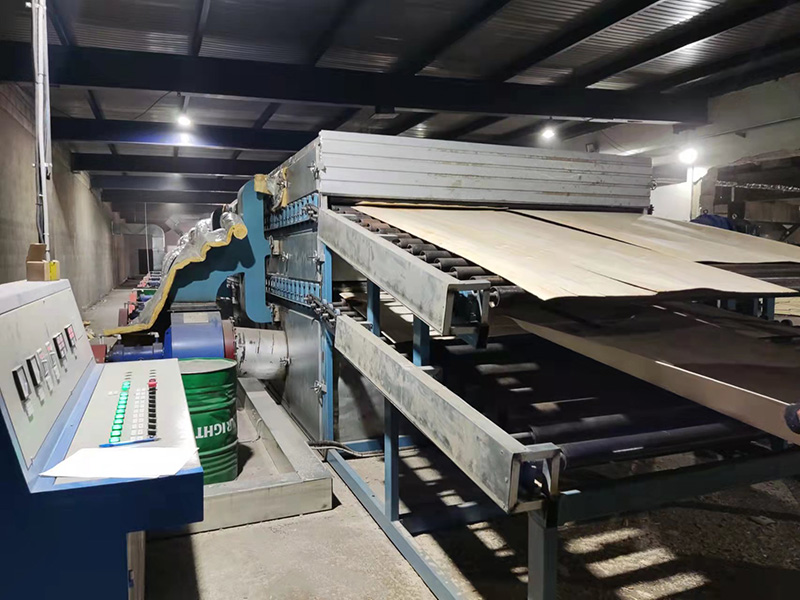
For readers who want to see Shine’s published roller configuration details directly, the relevant product page is the Low Cost Veneer Dryer Machine listing.
Shine states that the drying cost of its vertical dryer is less than $8/M³, and positions this figure as 30–60% of the drying cost of other dryers.
However, Shine’s own pages also make it clear that this cost positioning is tied to how the vertical solution is designed and deployed:
Low machine cost is linked to Shine’s description of standardization and modular production of vertical dryer parts, intended to reduce production losses and improve working efficiency.
High drying output is linked to the 30–80% higher loading capacity claim from the vertical plywood method.
High thermal efficiency and low drying cost are presented as outcomes of the vertical arrangement and supported systems described on the product pages.
So, the most procurement-safe way to interpret the “less than $8/M³” statement is to treat it as a published cost position for Shine’s vertical dryer when used within the intended application range—core plate, partial surface, bottom plate, and veneers with low flatness requirements.
A purchasing decision usually becomes clearer when the questions follow the same order as production reality.
Shine explicitly positions its vertical core veneer dryer machine for core, partial surface, and bottom veneer, and notes it can be used for veneers with low flatness requirements. That single line often decides whether the Vertical Veneer Dryer is a direct match, or whether a different dryer configuration should be evaluated for certain surface needs.
Shine publishes different moisture outcomes for different vertical models, for example 0–5% versus within 20%. Final selection should align with what the next station in your plywood veneer drying line needs.
Shine states that this equipment is assembled on the customer’s factory site, enabling installation according to the customer’s location requirements. Shine also states that the vertical core veneer dryer type can be run with 2 workers per shift, while the FBH30-20 parameter table lists 3 workers.
In many plants, a Veneer Drying System is not only the drying chamber—it also includes how you stage feeding, discharge, and internal transport. Shine’s vertical description highlights chain conveying into the drying room for circulating drying, and the roller configuration provides a different layout reference point.
For readers evaluating vertical equipment in a core-focused line, Shine’s Vertical Plywood Core Veneer page compiles several of the core application statements and the FBH30-20 parameters.
It is mainly used for drying core plate, partial surface, and bottom plate, as described on Shine’s vertical dryer pages.
Shine states the vertical core veneer dryer can be used for veneers with low flatness requirements, which implies buyers should confirm fit carefully where higher flatness is required.
Shine describes the vertical dryer as suitable for cutting first and then drying, and notes it is especially suitable for the drying of thick veneers.
Shine describes four sections: Feeding area, Heating area, Cooling area, and Discharging area.
Yes. Shine states the equipment needs to be assembled on the customer’s factory site, and can be installed according to the customer’s specific location requirements.
Shine publishes that the drying cost of its vertical dryer is less than $8/M³, and positions it as 30–60% of the drying cost of other dryers.
Based on Shine’s published tables, buyers typically compare moisture outcome, capacity or output, overall size, total power, and labor.
Copyright By © Shandong Shine Machinery Co.,Ltd
 ไทย
 Indonesia
 Melayu
 Tiếng Việt
 Pусский
 Portugues
 Français
 Deutsch
 日本語
 한국어
 العربية
 Italiano
 Polski
 Nederlands
 Türk dili
 हिन्दी
 Ελληνικά
 Svenska
 Español



