When plywood bonding becomes unstable, the gluing line is often adjusted first. The more practical starting point, however, is frequently the veneer itself. In precision plywood veneer drying, an 8–10% moisture target shouldn't be treated as a simple number on a production sheet. This needs to be linked with drying temperature, residence time, veneer thickness, and cooling. Shine Machinery’s roller and jet dryer specifications show why this matters: selected models use adjustable drying temperatures of 140–200°C, temperature-control accuracy of ±5°C, and veneer transport speeds of 5–22 m/min to achieve optimal veneer drying from fresh veneer to about 8–10% moisture.

Moisture content describes how much water remains in the veneer after drying. In production, however, the average moisture value is only part of the story. A batch can appear acceptable while individual sheets still vary enough to affect glue spreading, pressing behavior, and panel stability. This highlights why the veneer dryer machine's operating condition is just as crucial as the final moisture reading.
A practical veneer dryer machine is expected to support a defined downstream process, not simply remove as much water as possible. Shine Machinery’s GTH30-38 plywood roller veneer dryer, for example, is specified for 0.8–8 mm veneer and targets drying fresh veneer to about 8–10% moisture. Its drying temperature is adjustable from 140 to 200°C, with ±5°C temperature-control accuracy and a veneer transport speed range of 5–22 m/min.
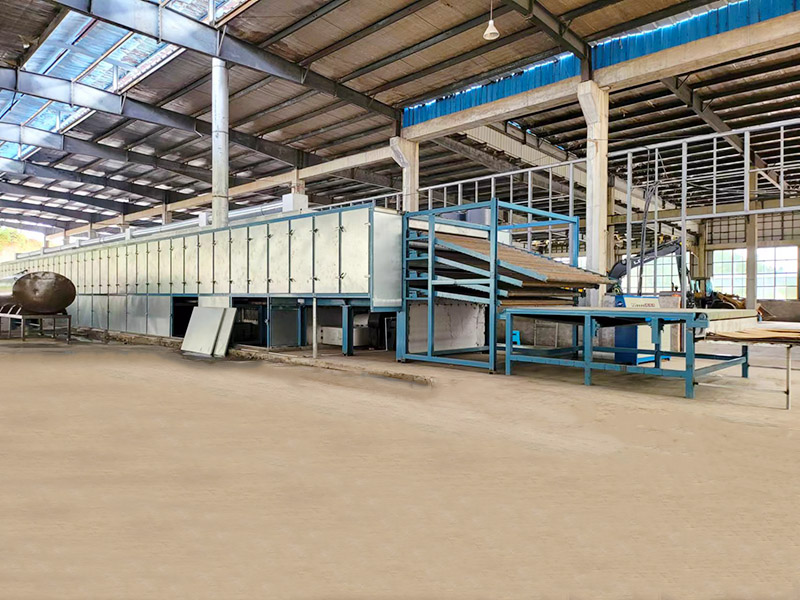
For buyers comparing equipment, this combination is important. Temperature sets the drying intensity, while transport speed affects the time each sheet remains inside the dryer. Ignoring either makes the moisture target hard to achieve consistently across varying veneer thicknesses or initial moisture levels, which is key for effective veneer drying.
High drying temperature alone doesn't dictate the final moisture content. In a continuous Veneer Drying System, residence time is controlled by conveyor speed. If the veneer moves too quickly, moisture may remain above the required level. If it remains too long under intense heat, the veneer might become overly dry, complicating handling and subsequent processing. Achieving precise plywood veneer drying requires a delicate balance.

Shine Machinery’s GTH30-38 roller dryer combines automatic temperature control with speed regulation. Its structure includes a 34 m heating section and a 4 m cooling section. Driven upper and lower rollers convey the veneer through the dryer, while heated air is directed toward the veneer surfaces. The cooling section is not merely an add-on; it's an integral part of the continuous process before the veneer exits.
The GTH30-36 roller model follows the same control logic. It is also specified with a 140–200°C adjustable temperature range, ±5°C temperature-control accuracy, and 5–22 m/min veneer transport speed. Its drying capacity is listed at 110 m³/day, while the GTH30-38 is listed at 120–130 m³/day. Both target fresh veneer to about 8–10% moisture, ensuring consistent veneer drying results.
Dryer configurations should be chosen based on process requirements, not solely on purchase price. For an 8–10% moisture endpoint, Shine Machinery’s roller and jet dryer specifications provide direct reference points. The GTH30-28 Veneer Jet Dryer Machine handles 0.8–8 mm veneer, uses a 140–200°C adjustable temperature range, maintains ±5°C temperature-control accuracy, and runs at 5–22 m/min transport speed. Its stated drying capacity is 80–85 m³/day, with operating cost listed at $6–12/m³ for labor, fuel, and electricity.
A Vertical Veneer Dryer serves a different comparison point. Shine Machinery’s FBH30-10 vertical dryer is specified for fresh veneer dried to 0–5%, with a capacity of 1.5 m³/h. The FBH30-20 vertical plywood veneer model is specified for fresh veneer to within 20%, with a capacity of 1.2–1.5 m³/h. These details show why a vertical configuration should be matched to its stated moisture endpoint and application conditions rather than assumed to fit an 8–10% target automatically for veneer drying.
| Dryer configuration | Model | Documented final moisture | Capacity | Key control or cost point |
|---|---|---|---|---|
| Roller veneer dryer | GTH30-38 | About 8–10% | 120–130 m³/day | 140–200°C, ±5°C, 5–22 m/min |
| Roller veneer dryer | GTH30-36 | About 8–10% | 110 m³/day | 140–200°C, ±5°C, 5–22 m/min |
| Jet veneer dryer | GTH30-28 | About 8–10% | 80–85 m³/day | $6–12/m³ operating cost |
| Vertical dryer | FBH30-10 | 0–5% | 1.5 m³/h | Drying cost below $8/m³ |
| Vertical plywood veneer | FBH30-20 | Within 20% | 1.2–1.5 m³/h | Vertical core veneer application |
A low-cost veneer dryer machine only makes sense when the final moisture requirement, veneer size, and production capacity are clearly defined. Shine Machinery lists the GTH30-36 roller dryer cost at $6–12/m³, including labor, fuel, and electricity. The vertical dryer information lists drying cost below $8/m³.
These figures are useful for comparing different models. However, they shouldn't be separated from the moisture target, veneer thickness, heat source, and throughput. A lower cost per cubic meter can lose its value if the selected equipment does not match the required glue-ready moisture condition for optimal veneer drying.
Heat source is another practical factor in plywood veneer drying. The GTH30-36 and GTH30-38 roller dryers are specified with biomass burners, with other options available. Shine Machinery’s roller dryer information also identifies steam, natural gas, and heat-transfer oil as alternative heat sources on relevant configurations. This enables buyers to compare dryers not just by price, but also by the specific energy conditions of their own mill.
For international buyers evaluating a veneer dryer machine manufacturer or supplier, the key procurement question isn't just about maximum temperature. Instead, it's about whether the process can consistently achieve the required veneer condition. In drying veneer for plywood, the specification should connect the 8–10% target with measurable operating parameters.
A practical equipment inquiry should include:
Incoming veneer moisture and expected variation
Veneer thickness and sheet dimensions
Required final moisture after drying
Required daily or hourly drying capacity
Drying temperature range and temperature-control accuracy
Conveyor speed range and residence-time adjustment
Heating and cooling section configuration
Preferred heat source
Estimated labor, fuel, and electricity cost per cubic meter
Shine Machinery’s roller and jet dryer data give buyers a clear way to compare moisture target, temperature control, and transport speed together. When thick core veneer, a compact layout, or less stringent flatness requirements are primary concerns, the vertical dryer range can be evaluated based on its specific documented moisture and capacity parameters for veneer drying.
Stable plywood bonding begins before glue application. If the veneer entering the gluing line lacks proper control, adjustments to glue spread or pressing conditions might only conceal the underlying problem. For an 8–10% target, a Veneer Drying System should be evaluated as a combined control process: temperature accuracy, speed regulation, veneer thickness, incoming moisture, and cooling all work together. This integrated approach is vital for consistent plywood veneer drying.
Shandong Shine Machinery Co., Ltd and Shine Machinery provide roller, jet, and vertical veneer dryer machine configurations at www.veneersdryer.com. For production lines focused on plywood veneer drying, the key lesson is direct: do not specify the moisture endpoint without also specifying the temperature-control accuracy and transport-speed range that make the endpoint repeatable.
Yes. Shine Machinery’s GTH30-36 and GTH30-38 roller dryer specifications state that fresh veneer can be dried to about 8–10% moisture. Both list a 140–200°C adjustable temperature range, ±5°C temperature-control accuracy, and 5–22 m/min veneer transport speed for precise veneer drying.
No. Temperature accuracy is important, but it works together with veneer transport speed, residence time, veneer thickness, and incoming moisture. Shine Machinery’s specified roller and jet systems combine automatic temperature control with speed regulation for comprehensive veneer drying.
No. Shine Machinery’s FBH30-10 vertical dryer is specified for fresh veneer to 0–5%, while the FBH30-20 vertical plywood veneer model is specified for fresh veneer to within 20%. The selected configuration should match the required endpoint for the specific veneer drying application.
Buyers should compare final moisture requirement, veneer thickness, capacity, temperature range, temperature-control accuracy, transport-speed range, heating and cooling layout, and heat source to ensure an effective veneer dryer machine purchase.
Plywood is built from glued veneer layers. If veneer moisture varies significantly before gluing, the bonding process becomes harder to stabilize. A controlled dryer helps deliver veneer at the moisture condition required by the next production stage, leading to stronger, more reliable plywood. This underscores the importance of consistent veneer drying.
Copyright By © Shandong Shine Machinery Co.,Ltd
 ไทย
ไทย Indonesia
 Melayu
 Tiếng Việt
 Pусский
 Portugues
 Français
 Deutsch
 日本語
日本語 한국어
한국어 العربية
 Italiano
 Polski
 Nederlands
 Türk dili
 हिन्दी
 Ελληνικά
 Svenska
 Español


