Running a Vertical Veneer Dryer with two workers per shift can be realistic—but only when the core veneer process limits match the dryer’s configuration. In practice, stable staffing is determined less by the machine category name and more by the required final moisture content, the targeted throughput, how feeding/discharging is organized, and who takes responsibility for the heat source.
Shine Machinery’s Vertical Veneer Drying Machine is specified to operate with 2 workers per shift and is positioned for core plate, partial surface, and bottom plate drying—especially for thick veneers and a cut-first-then-dry process. In the same vertical category, the FBH30-20 configuration lists 3 workers, noting that the burner operator can also handle other tasks such as operating a forklift. This contrast is exactly why buyers should define staffing around process boundaries rather than assumptions.
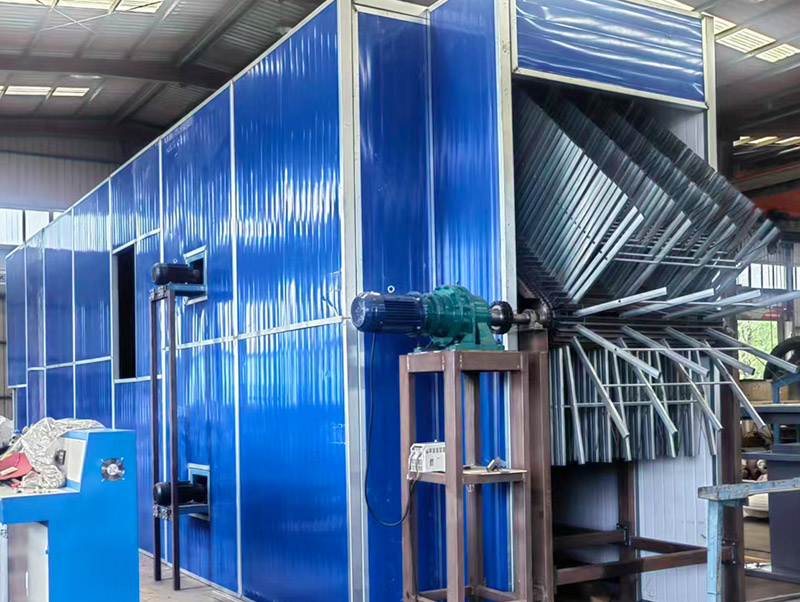
In plywood veneer drying, three operational boundaries consistently determine whether two workers per shift can keep a line stable.
Shine Machinery lists different moisture targets across vertical models:
FBH30-20: fresh veneer to within 20% moisture content, capacity 1.2–1.5 m³/h, total power 36.3 kW, labor 3, including a dedicated burner operator who may also take on other duties.
FBH30-13: fresh veneer dried to 0–5%, output 2 m³/h, total power 15 kW, and listed fuel consumption of 200 kg/h.
A lower final moisture requirement typically requires tighter process attention, especially around heating stability and handling rhythm, so staffing should be evaluated against the moisture endpoint the line must reliably hit.
A veneer dryer machine may look simple on paper, but the handling cycle of feeding in and discharging out is what consumes labor minute by minute. Shine Machinery explicitly states that the length of its vertical veneer dryer is determined by output and that the equipment can be designed per project requirement. That means the correct question is not only “How many workers?” but also “What output must those workers sustain per shift?”
For the Vertical Veneer Drying Machine, Shine Machinery specifies the heat source as a 900,000 kcal hot air stove. In the FBH30-20 configuration, labor is listed as three workers and explicitly includes the burner operator role with concurrent task capability. This is a practical reminder: burner or heat-source duty is labor, and it must be assigned clearly when planning two-worker shifts.
Shine Machinery describes the Vertical Veneer Drying Machine as the main equipment in plywood production and divides it into four areas:
Feeding area → Heating area → Cooling area → Discharging area
This sequence matters for labor planning because two-worker stability depends on whether one operator can keep feeding consistent while the other manages discharge and keeps an eye on the heating and cooling transition points.
The vertical tunnel-type core veneer dryer is described as mainly used for drying core plate, partial surface, and bottom plate, and it is positioned for veneers with low flatness requirements. It is also described as suitable for thick veneers and a cutting first and then drying production process, which affects how stacks are prepared and moved.
To see the equipment format commonly referenced in planning documents, buyers often start with the product page for the Vertical Veneer Drying Machine and confirm the shift arrangement against the line’s intended output.
A key reason vertical systems are considered for lean staffing is how loading and airflow are configured.
Shine Machinery describes the vertical veneer dryer as having a unique quick-loading structure, designed to make veneer loading fast and to save labor and cost. It also describes a hot-air circulation approach with large hot air volume, uniform airflow, uniform temperature, and a countercurrent drying cycle to support fast drying and uniform quality.
For procurement teams, this matters because two-worker operation is most reliable when the dryer helps reduce micro-stops—small interruptions caused by slow loading, uneven movement, or repeated handling corrections.

If you want to review that configuration in more detail, the Vertical Core Veneer Dryer Machine page highlights quick-loading and the internal hot-air circulation mode as central design points.
Shine Machinery states several positioning points for its vertical dryers:
Composite drying cost stated as less than $8/M³, described as 30–60% of the drying cost of other dryer types such as roller, mesh, and wire rope veneer dryers.
Higher loading capacity described as 30–80% higher than other dryer types due to the vertical plywood method.
Small footprint, described as about two-thirds of the roller dryer’s area.
These claims are relevant to a Low Cost Veneer Dryer evaluation when buyers are trying to balance floor space, labor planning, and cost targets.
Shine Machinery describes its Roller Core Veneer Dryer Machine as focusing on veneer quality outcomes and control features, including:
Dried veneer with uniform moisture content and a flat result without buckle or end waviness.
Veneer after drying described as free of splits with a surface condition suitable for gluing.
An automatic control system positioned as helping save labor cost, supporting easy operation and low failure rate.
Frequency conversion used to adjust transmission speed and temperature automatically for the desired drying effect.
In other words, a roller system may be shortlisted when the purchasing priority is tight moisture uniformity and flatness outcomes with control features that can reduce operator intervention.
When a buyer wants a two-worker plan to be stable, the most useful approach is to confirm the following items before finalizing a configuration:
Moisture endpoint: confirm whether the project target is “within 20%” as shown for FBH30-20 or “0–5%” as shown for FBH30-13, because the endpoint changes operational intensity.
Capacity and rhythm: confirm the capacity requirement and match it to a dryer length that is designed around output.
Handling map: define who feeds, who discharges, and how stacks or boards move in and out without bottlenecks.
Heat-source duty: explicitly assign burner or hot-air stove responsibility, and any concurrent tasks, as part of headcount.
Quality priority: decide whether the project is best aligned with vertical drying for core plate and low flatness requirements, or roller drying that emphasizes uniform moisture and flat veneer.
For roller-style buyers evaluating a dedicated low-cost configuration, the Low Cost Veneer Dryer Machine page lists a roller dryer type with working width 3 m, veneer thickness 0.8–8 mm, heating area length 32 m, drying capacity 50–60 m³/day, and a biomass burner heat source, with other options available.
In procurement discussions, “two workers per shift” should be treated as an operating condition rather than a marketing label. Shine Machinery’s catalog shows both:
A vertical configuration explicitly described as requiring 2 workers per shift.
A vertical core veneer configuration that lists 3 workers and includes a burner operator role.
The difference is not contradictory—it reflects that core veneer process limits, including moisture endpoint, output, handling, and heating duty, decide whether a two-worker plan can run smoothly day after day.
Shine Machinery’s Vertical Veneer Drying Machine is described as requiring 2 workers per shift. Other vertical configurations, such as the FBH30-20, list 3 workers, so staffing should be matched to the specific model and operating responsibilities.
From Shine Machinery’s published product descriptions, the most direct limits are the final moisture content target, the required output, which drives handling frequency, and the assigned heat-source responsibility, including hot air stove or burner duty.
Shine Machinery states the heat source is a 900,000 kcal hot air stove for its Vertical Veneer Drying Machine.
Shine Machinery lists FBH30-20 as drying fresh veneer to within 20% moisture content, with capacity 1.2–1.5 m³/h and labor 3.
Shine Machinery lists FBH30-13 as drying fresh veneer to 0–5% moisture content, with output 2 m³/h and total power 15 kW.
Shine Machinery positions its roller core veneer dryer machine around uniform moisture content, flat veneer quality, and an automatic control system with frequency conversion to adjust speed and temperature.
Copyright By © Shandong Shine Machinery Co.,Ltd
 ไทย
ไทย Indonesia
 Melayu
 Tiếng Việt
 Pусский
 Portugues
 Français
 Deutsch
 日本語
日本語 한국어
한국어 العربية
 Italiano
 Polski
 Nederlands
 Türk dili
 हिन्दी
 Ελληνικά
 Svenska
 Español


