A compact Vertical Veneer Dryer can make a plywood line feel instantly “bigger” by freeing up valuable floor space. Shine Machinery positions its vertical core veneer dryer design around three-dimensional veneer loading, and states that the equipment footprint can be about two-thirds of a roller dryer—an attractive argument when workshop space is tight.
But footprint is only one part of real-world planning. A Veneer Drying System still needs safe, practical access for inspections, cleaning, adjustments, and routine servicing. If the service aisles are reduced too aggressively, the space saved by a smaller veneer dryer machine can quickly turn into lost uptime during maintenance.

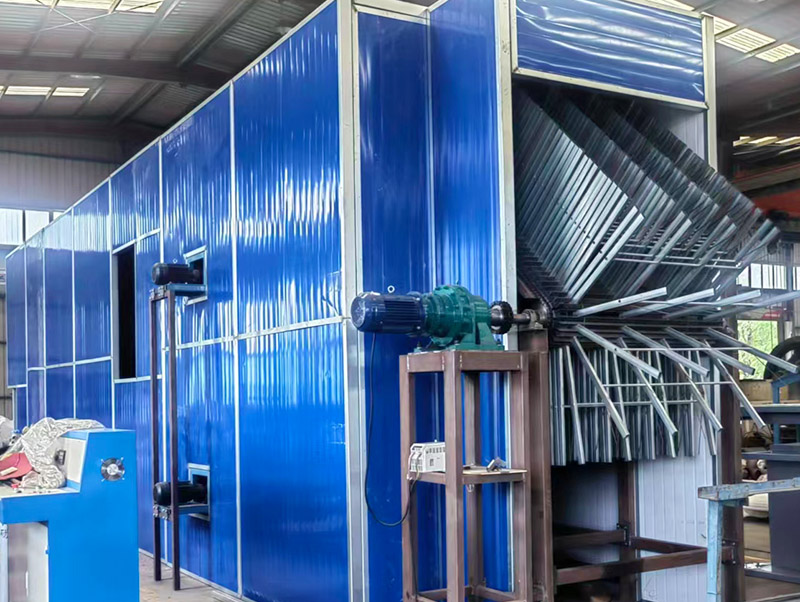
In plywood veneer drying, “smaller footprint” is often misunderstood as “smaller installation area.” They are not the same.
Equipment footprint is the area physically occupied by the machine body.
Maintenance clearance is the working space reserved around the machine so operators and maintenance staff can safely access critical components.
Even when a Vertical Veneer Dryer occupies less floor area than a roller dryer, it still relies on the same core functions—conveying, heating, airflow, and discharge—each of which requires access. Planning a layout that treats maintenance clearance as a simple percentage of footprint is the common mistake: the veneer dryer machine becomes harder to service, not cheaper to operate.
Buyers typically compare a Vertical Veneer Dryer and a roller dryer around output, quality targets, energy cost, and available space. Shine Machinery presents both categories with clear positioning.
Shine describes its vertical core veneer dryer as a continuous core veneer drying machine using three-dimensional loading, designed for space utilization. It is also positioned as a Low Cost Veneer Dryer, with a composite drying cost described as less than $8/M³ and stated as 30–60% of other dryer types.
The vertical equipment description also emphasizes:
a quick-loading structure for faster veneer loading speed and labor saving,
a hot air circulation mode with large hot air volume,
uniform airflow and uniform temperature across sections,
a countercurrent drying cycle for fast drying and uniform quality.
(For a product-level introduction, see Shine’s page for the vertical core veneer dryer machine.)
On its roller core veneer dryer page, Shine stresses finished-veneer characteristics important in plywood veneer drying—including uniform moisture content and veneer that is flat without buckle or end waviness, with a surface condition suitable for gluing.
In other words, the roller dryer description focuses strongly on veneer surface condition after Drying Veneer, while the Vertical Veneer Dryer description focuses strongly on footprint efficiency, loading method, and operating cost positioning.
Shine describes a vertical veneer drying machine as being composed of four parts:

Feeding area
Heating area
Cooling area
Discharging area
This is a useful way to plan a Veneer Drying System layout, because each zone creates its own space demands beyond the equipment footprint.
For the full category description, see Shine’s product page for the Vertical Veneer Drying Machine.
The vertical dryer is described as having a quick-loading structure and fast loading speed. In layout terms, that advantage only shows up when the infeed side is not cramped.
Practical planning points:
keep enough working room for veneer staging and smooth feeding,
avoid placing columns, walls, or other machines where they interfere with loading tasks,
ensure the infeed conveying path stays easy to observe and keep clean.
When a vertical veneer dryer machine is installed too close to obstacles, operators slow down—so the line loses the benefit of fast loading even though the dryer itself is compact.
Shine’s vertical core veneer dryer description includes a built-in combustion furnace process, and notes the ability to burn waste wood handles and branches left by rotary cutting. It also states a drying-area temperature range of 100–130°C, adjustable according to demand.
This zone should be planned for safe, direct access because heating and airflow are not “set-and-forget” parts of plywood veneer drying. When service aisles are too narrow, routine inspection becomes inconvenient, which can increase downtime over the long term.
The cooling area is listed as one of the four functional parts of the vertical system. In layout terms, it is where the line transitions from drying to downstream handling.
A compact footprint is helpful here—but only if the space still allows operators to observe discharge condition and perform routine checks.
Shine’s vertical design aims to dry quickly and support uniform quality; the discharge side is where that effort is collected and handled.
Reserve space so dried veneer can be collected and moved without congestion. If discharge handling gets blocked, the whole Veneer Drying System effectively becomes “smaller” than its nameplate capability.
Shine provides model parameters that can be used as a starting point for layout calculations.
For example, the FBH30-20 model is listed with an overall size of 20 × 7 × 4 m, capacity 1.2–1.5 m³/h, and “Fresh veneer to within 20%” moisture content. Total power is listed as 36.3 kW, with key components including hot air blower power 9 kW, traction motor 4 kW, intake air blower 7.5 kW, and internal burner blower 1.1 kW.
Those numbers help define the equipment boundary, but aisle planning should be based on the four-zone workflow and the need to reach components during normal operation.
(For the FBH30-20 specification page, see Shine’s Plywood Vertical Veneer Dryer listing.)
Shine promotes the vertical dryer as compact and cost-effective, but the most effective installations treat service access as part of the purchase—not a later compromise.
A simple way to keep decisions consistent is to plan clearance around tasks:
Inspection tasks: space to open access points and visually check key sections
Cleaning tasks: room to keep the area around conveying and airflow components clean
Servicing tasks: working space for routine maintenance activities without needing to move other equipment
Daily operation tasks: safe movement routes for operators around feeding and discharge
This approach keeps the “two-thirds footprint” advantage meaningful, because it avoids creating bottlenecks around maintenance.
Shine notes that the vertical tunnel-type core veneer dryer is mainly used for drying core plate, partial surface, and bottom plate, is suitable for the production process of cutting first and then drying, and is suitable for veneers with low flatness requirements.
For buyers, that means selection is not only about space. It is about matching your target veneer type and process route to the right Veneer Drying System.
For a broader view of the vertical dryer category, you can also explore the vertical veneer dryer section.
Shine states that its vertical core veneer dryer uses three-dimensional veneer loading and covers an area of about two-thirds of the roller dryer.
The vertical dryer footprint and maintenance clearance are different planning items. Aisles should be reserved around feeding, heating, cooling, and discharging areas so routine access remains practical.
Shine describes the vertical dryer as having high thermal efficiency and a composite drying cost less than $8/M³, and notes it can burn waste wood handles and branches left by rotary cutting.
Shine lists a drying-area temperature range of 100–130°C, adjustable according to demand.
Shine describes four parts: Feeding area, Heating area, Cooling area, and Discharging area.
Shine states it is mainly used for drying core plate, partial surface, and bottom plate, and it can be used for veneers with low flatness requirements.
Copyright By © Shandong Shine Machinery Co.,Ltd
 ไทย
 Indonesia
 Melayu
 Tiếng Việt
 Pусский
 Portugues
 Français
 Deutsch
 日本語
 한국어
 العربية
 Italiano
 Polski
 Nederlands
 Türk dili
 हिन्दी
 Ελληνικά
 Svenska
 Español



