Fresh veneer shouldn't be dried to the lowest possible moisture figure just for the sake of a lower number. For core veneer and plywood production, a smarter approach is to define the final application first, then set the target moisture, and only after that select the right Vertical Veneer Dryer configuration. It's crucial when the target is fresh veneer dried to 0–5% moisture, because that requirement represents a different process route from fresh veneer dried to within 20%.

In plywood veneer drying, final moisture isn't an isolated number. It's connected to the veneer’s role in the board structure, the material's thickness, the downstream process, and the level of flatness required. Our vertical drying equipment is designed mainly for core plate, partial surface, and bottom plate drying. It's also suitable for thick veneer, the cut-first-then-dry process, and veneer applications with lower flatness requirements.
Understanding the application context is key. A buyer shouldn't automatically ask a veneer dryer machine to dry every sheet to 0–5% moisture. We offer one vertical configuration for fresh veneer dried to 0–5%, while another configuration is specified for fresh veneer to within 20%. These aren't just different settings on a single machine; they represent distinct configuration options.
| Model | Moisture target | Capacity | Overall size | Total power |
|---|---|---|---|---|
| FBH30-13 | Fresh veneer dried to 0–5% | 2 m³/h | 13 × 3 × 4 m | 15 kW |
| FBH30-20 | Fresh veneer to within 20% | 1.2–1.5 m³/h | 20 × 7 × 4 m | 36.3 kW |
FBH30-13 is also listed with fuel consumption of 200 kg/h. The practical conclusion is straightforward: when fresh veneer must reach 0–5%, the specification discussion should begin with the end use and then move to the correct veneer dryer model.

An effective veneer dryer machine selection process keeps production reality ahead of equipment preference. Buyers comparing vertical systems should first confirm whether the veneer is intended for core plate, partial surface, or bottom plate use. They should also record veneer dimensions, thickness, required final moisture, hourly output, and factory installation conditions.
For a production line requiring fresh veneer dried to 0–5%, the FBH30-13 is the relevant documented configuration. For a line targeting fresh veneer to within 20%, the FBH30-20 is the corresponding configuration. Opting for a lower moisture target without a clear production reason can lead to an unsuitable discussion about capacity, power, machine size, and operating cost.
That's also why we recommend buyers looking for a China veneer dryer manufacturer or supplier prepare detailed process information before requesting a quotation. A clear specification helps us evaluate the project more accurately and avoids comparing machines that serve different drying endpoints.
Our vertical veneer drying machine is designed with four main areas: feeding, heating, cooling, and discharging. This structure clarifies why drying should be treated as a complete material-flow process rather than only a heating operation.
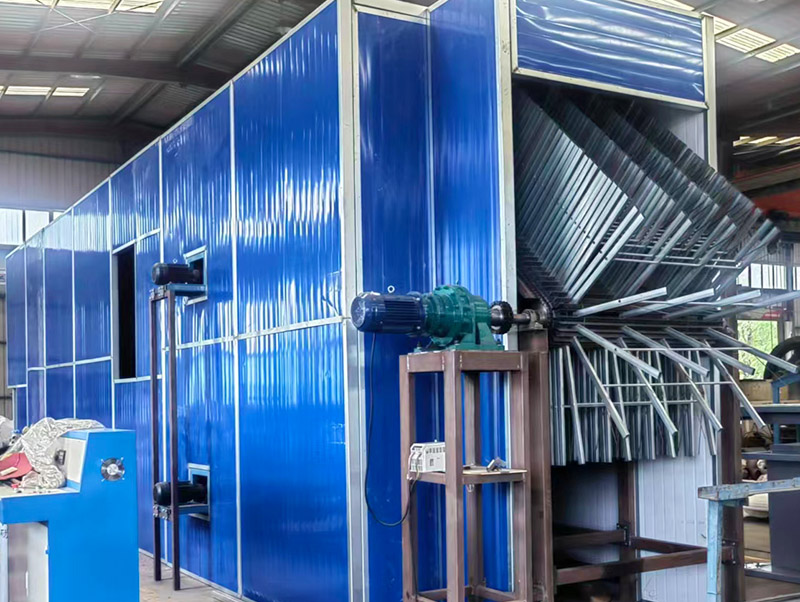
During Drying Veneer, operators can adjust air volume, heating temperature, material residence time, and feeding speed to achieve the required drying effect. The equipment utilizes a flap structure, ensuring the material keeps turning with the flap during drying to support consistency in product quality. These parameters are interconnected: residence time and feeding speed influence how long the veneer stays in the dryer, while air volume and heating temperature affect the drying conditions inside the machine.
Industry research also highlights initial veneer moisture, thermal conditions, airflow, and conveyor speed as important process factors. In practice, this supports the same basic principle: a change in target moisture shouldn't be reduced to one simple adjustment. It should be matched with veneer thickness, starting moisture, output requirements, and the intended plywood use.
Cost evaluation becomes meaningful only after the moisture target is clear. Our vertical dryers boast a drying cost of less than $8/m³, which is 30–60% of the drying cost of other veneer dryers. Furthermore, our vertical plywood method boosts veneer loading capacity by 30–80% compared with other dryers.
For procurement teams, a Low Cost Veneer Dryer shouldn't mean the cheapest-looking machine on paper. It should mean a configuration that can meet the required moisture target, support the expected output, fit the installation site, and control drying cost over regular production.
Installation conditions are part of this calculation. We ensure the equipment is assembled at the customer’s factory site and can be installed according to specific location requirements. Equipment size can be customized according to actual veneer dimensions, and dryer length can be designed around project output requirements.
If the production process clearly requires fresh veneer dried to 0–5%, the starting point is our FBH30-13 Vertical Veneer Dryer. Its listed output is 2 m³/h, machine size is 13 × 3 × 4 m, total power is 15 kW, and fuel consumption is 200 kg/h. The next step is to coordinate air volume, heating temperature, residence time, and feeding speed around that endpoint.
If the core veneer process targets fresh veneer to within 20%, the FBH30-20 is the matching configuration. It is listed with 1.2–1.5 m³/h capacity, 20 × 7 × 4 m overall size, 36.3 kW total power, and around 15 tons of weight. In this case, moving the target down to 0–5% should only happen when the downstream plywood veneer drying process genuinely requires it.
Before confirming a vertical dryer configuration, buyers can make the discussion more efficient by preparing the following details:
Veneer application: core plate, partial surface, or bottom plate.
Veneer thickness and dimensions.
Required final moisture, such as 0–5% or within 20%.
Required hourly output.
Factory installation space and layout conditions.
Preferred evaluation focus: capacity, drying cost, footprint, or operating convenience.
This checklist helps align the Veneer Drying System with the actual production task. It also prevents the common mistake of treating 0–5% moisture as the default target for all fresh veneer.
The most useful decision sequence is: end use, target moisture, dryer configuration, operating parameters, then cost and output evaluation. The FBH30-13 provides the documented route for fresh veneer dried to 0–5%, while the FBH30-20 serves a fresh veneer target within 20%.
For those considering Shine Machinery, Shandong Shine Machinery Co., Ltd, or a leading China top veneer dryer factory option, the key is to provide project details early. The more clearly the veneer task is defined, the easier it becomes to choose a vertical veneer dryer that supports stable drying, suitable output, and practical operating cost. Product information can be reviewed at www.veneersdryer.com.
No. The FBH30-13 is specified for fresh veneer dried to 0–5%, while the FBH30-20 is specified for fresh veneer to within 20%. The correct target should always align with the plywood or core veneer application.
The FBH30-13 is listed for fresh veneer dried to 0–5%. Its documented output is 2 m³/h, with a machine size of 13 × 3 × 4 m and total power of 15 kW.
Adjustable parameters include air volume, heating temperature, material residence time, and feeding speed.
It's primarily used for drying core plate, partial surface, and bottom plate. It also suits thick veneer, cut-first-then-dry production, and veneer with lower flatness requirements.
Buyers should provide veneer size, thickness, application, target moisture, output requirement, and factory installation conditions.
Copyright By © Shandong Shine Machinery Co.,Ltd
 ไทย
ไทย Indonesia
 Melayu
 Tiếng Việt
 Pусский
 Portugues
 Français
 Deutsch
 日本語
日本語 한국어
한국어 العربية
 Italiano
 Polski
 Nederlands
 Türk dili
 हिन्दी
 Ελληνικά
 Svenska
 Español


