A published veneer dryer operating cost per m3 of USD 6–12/m³ looks clear at first glance—until you compare it with your own electricity tariff, labor rates, fuel availability, and real output per shift. This article explains what that reference range typically includes on Shine Machinery product pages, and how buyers can recalculate veneer dryer operating cost per m3 using the same logic and the technical data shown for specific machines.

Across multiple Shine Machinery listings for a veneer dryer including single-deck roller dryers, four-deck roller dryers, core dryer machines, and jet dryers, the operating-cost reference is presented as “Cost: 6–12$/m3 (Labor+Fuel+Electricity)”.
In practical purchasing discussions, it helps to treat this as a scope definition rather than a promise. In other words, the veneer dryer operating cost per m3 on the product page is framed as a combined figure that typically includes:
Labor tied to operating the dryer line
Fuel used to generate drying heat, commonly shown as a biomass burner on these configurations, with other options available
Electricity for items such as fans and drive systems, where some pages also provide actual electricity consumption figures
A separate example is also provided for a specific four-deck roller dryer listing: the comprehensive veneer drying cost is stated as USD 12/m³, inclusive of labor cost, fuel cost, and electric power.
To localize a reference value, keep the calculation aligned to one consistent time window per hour, per shift, or per day, and then divide by the actual dried output achieved in that same window.
A straightforward structure is:
Veneer dryer operating cost per m3 = (Labor + Fuel + Electricity) ÷ Dried output (m³)
Two reminders matter for cost comparisons:
If output drops while labor, fuel, and electricity remain similar, the veneer dryer operating cost per m3 rises.
If you compare two mills or two lines drying different veneer thicknesses or targeting different final moisture, the same USD/m³ format can hide very different drying tasks.
Some buyers try to estimate operating cost by looking only at installed power. Shine Machinery pages also distinguish installed power from actual electricity consumption, which is typically the more direct input for estimating electricity cost.
For the GTH30-20 Core Veneer Drying Machine listing, the following figures are shown: total power 145.5 kW, actual electricity consumption about 100 kWh per hour, and drying capacity 2.5 m³/h.
That allows a working calculation:
Electricity per cubic meter = 100 kWh/h ÷ 2.5 m³/h = 40 kWh/m³
Electricity cost (USD/m³) = 40 × your local electricity price (USD/kWh)
This method also makes performance sensitivity easy to see: if your line runs below the published 2.5 m³/h, the electricity component inside the veneer dryer operating cost per m3 increases.
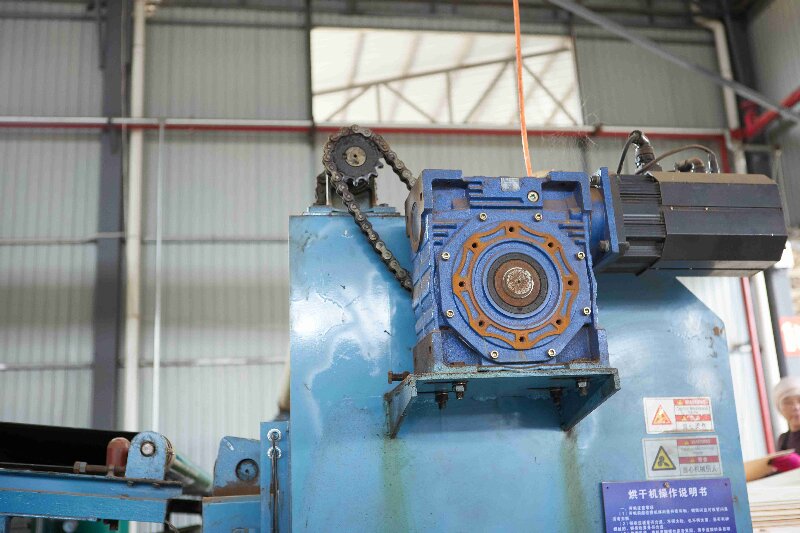
To help visualize what a multi-deck dryer line looks like in production, the GTH30-36 “Veneer Drying Process” page includes factory-context images.
On Shine Machinery product pages, the most frequently shown heat source is a biomass burner, with “other options available” stated on multiple listings.

One four-deck roller dryer configuration specifies a biomass burner, 10 ton, 6 million KCAL/h, and lists fuel types as crushed waste wood, tree bark, and wood chips. Separate wording on a biomass veneer dryer page describes the biomass burner as an exclusive patented product that can burn crushed wood chips and tree barks directly as fuel, positioned as a way to address waste accumulation and reduce fuel cost compared with traditional heat sources.
For buyers benchmarking a veneer dryer operating cost per m3, this matters because fuel cost can look very different depending on whether a mill purchases biomass, prepares it internally, or uses another heat-source option.
When shortlisting a Wood Veneer Machine for Drying Veneer, many procurement teams begin with the parameters that most directly affect throughput and cost allocation: working width, heating area length, and published capacity.
Below is a consolidated snapshot taken from Shine Machinery listings. Capacities are presented as shown on their respective pages.
| Equipment type (as listed) | Working width | Heating area length | Veneer thickness | Published capacity | Cost reference scope |
|---|---|---|---|---|---|
| Single-deck roller dryer (single deck 20m page) | 3 m | 16 m | 0.6–8 mm | 0.5–0.7 m³/h | 6–12$/m³ (Labor+Fuel+Electricity) |
| Roller drying machine for veneer (32 m zone page) | 3 m | 32 m | 0.8–8 mm | 110–120 m³/day | 6–12$/m³ (labor+fuel+electricity) |
| Four-deck roller dryer (4 deck roller dryer page) | — | — | 0.6–8 mm | around 120 m³/day | USD 12/m³ (labor+fuel+electricity) |
| Core dryer machine (48 m heating area page) | 3 m | 48 m | 0.8–8 mm | 150–160 m³/day | 6–12$/m³ (Labor+Fuel+Electricity) |
| Veneer jet dryer machine (24 m heating area page) | 3 m | 24 m | 0.8–8 mm | 80–90 m³/day | 6–12$/m³ (Labor+Fuel+Electricity) |
If you want to review original listings while keeping comparisons consistent, these product pages are commonly used as starting points: the 4 Deck Veneer Roller Dryer, the Core Veneer Drying Machine, the Core Dryer Machine, the Veneer Jet Dryer Machine, and the Roller Veneer Drying Equipment - Single Deck 20m.
Several Shine Machinery pages describe drying from fresh veneer to about 8–10% moisture, or down to 10% on the single-deck page. The four-deck roller dryer listing also specifies fresh veneer to 8–10%, with customized moisture content available.
For cost discussions, the key point is consistency: if one line is set up for a different veneer thickness range, different incoming moisture condition, or a different final target, then comparing veneer dryer operating cost per m3 without aligning those assumptions can lead to the wrong purchasing decision.
A practical procurement habit is to request a cost calculation using your own inputs—your electricity tariff, your labor structure, and your fuel pathway—while keeping the drying requirement consistent with your panel spec.
A buyer evaluating a China veneer dryer manufacturer or China veneer dryer supplier usually ends up comparing two things side by side:
Published capacity and configuration such as deck count, heating area length, and working width
A localized, mill-specific veneer dryer operating cost per m3 recalculated from the same cost scope—labor, fuel, electricity—using local rates and actual output
Shine Machinery product pages provide multiple reference points across dryer types with a consistent cost-scope definition. To explore configurations and specification ranges directly, visit Shandong Shine Machinery Co., Ltd; Shine Machinery at www.veneersdryer.com.
It is commonly presented as 6–12$/m³ (Labor+Fuel+Electricity), meaning a combined reference for labor, fuel, and electricity.
Yes. The four-deck roller dryer listing states a comprehensive veneer drying cost of USD 12/m³, inclusive of labor cost, fuel cost, and electric power.
Yes, when actual electricity consumption and capacity are both provided. For the GTH30-20 core veneer drying machine listing, the page shows about 100 kWh per hour at 2.5 m³/h, which implies 40 kWh/m³ under those conditions.
The listing describes a biomass burner configuration and states fuel types as crushed waste wood, tree bark, and wood chips.
Multiple listings show a 3 m working width and veneer thickness ranges such as 0.6–8 mm or 0.8–8 mm, depending on the specific product page.
Copyright By © Shandong Shine Machinery Co.,Ltd
 ไทย
 Indonesia
 Melayu
 Tiếng Việt
 Pусский
 Portugues
 Français
 Deutsch
 日本語
 한국어
 العربية
 Italiano
 Polski
 Nederlands
 Türk dili
 हिन्दी
 Ελληνικά
 Svenska
 Español



