Energy is one of the biggest cost lines in any veneer drying process, but “low power” only becomes meaningful when it is tied to a specific configuration—not just a nameplate motor total. In a continuous roller veneer dryer, electricity is mainly used to run the hot-air and cold-air circulation fans, as well as the conveying and traction systems that keep veneer moving steadily through the drying and cooling zones.
A practical way to evaluate a core dryer (or any wood veneer machine used for drying veneer) is to look at how airflow is generated and controlled, how heat is exchanged and distributed, and what the published operating electricity consumption looks like under a defined model configuration.

Fan selection has a direct relationship with the total machine power of a veneer dryer because fans run continuously through both heating and cooling sections. Shine Machinery states that the hot-air fan and cold-air fan of the dryer adopt the latest axial flow fan, and that this configuration can reduce the power consumption and greatly reduce the power of the whole machine, helping reduce later operating costs.
On the same theme, Shine’s factory information also highlights two energy-related configuration points used in its veneer drying equipment: a waste heat recovery system (30% reduction in energy consumption) and an axial flow fan (38% reduction in total power consumption). For buyers comparing suppliers, this framing is important: energy reduction claims are most credible when they are explicitly linked to identifiable subsystems inside the veneer dryer.
A veneer dryer’s air system alone does not determine finished quality. Several linked elements influence whether dry veneer leaves the dryer flat and workable for downstream steps (including a veneer hot press dryer stage in a plywood line).
One published design point is Shine’s step-by-step heat exchange approach. The heat exchanger is described as having different specifications in each section so that hot air can be emitted uniformly across the veneer. The stated outcome is dry veneer with uniform moisture content, flatness, no buckle or end waviness, and a surface condition suitable for gluing.
Another published element is frequency conversion control. Shine describes its roller veneer dryer as adopting frequency conversion control that can automatically adjust speed and temperature, and allowing an automatic feeding device to help reduce labor cost. In practice, this means the veneer drying process is treated as a controlled production step rather than a fixed-speed “set and forget” operation.

Shine publishes both total installed power and approximate operating electricity consumption for several models. This distinction matters: two veneer dryer models can look similar on installed power, yet differ in expected kWh per hour because of fan quantity, fan power, section length, and overall dryer configuration.
| Model | Decks | Total Power | Power Consumption (published) |
|---|---|---|---|
| GTH30-20 | 1 | 69 kW | About 50 kWh per hour |
| GTH30-28 | 1 | 70 kW | About 46 kWh per hour |
| GTH612-42 | 6 | 680.5 kW | About 410 kWh |
For reference, Shine’s GTH30-20 is published with a 3 m working width, a 16 m heating area, a 4 m cooling area, and a veneer thickness range of 0.6–8 mm. Its listed fan and drive elements include hot air blower power 7.5 kW (4 pc), traction motor 5.5 kW frequency control (1 pc), cold air blower 7.5 kW (1 pc), and an air intake fan 11 kW (1 pc).
The GTH30-28 biomass configuration is published with waste wood as heating material, a drying temperature range of 140–200°C adjustable, and automatic temperature and speed control. It also lists insulation thickness of 75–100 mm for the shell to help minimize heat loss and air leakage.
For higher-throughput requirements, Shine’s six-deck GTH612-42 is published with a 6120 mm working width, 36 m hot air section, 6 m cold air section, adjustable drying temperature 160–180°C, veneer speed 5–22 m/min, and moisture content target from fresh veneers to within 12%.
A continuous veneer drying process can be understood as five linked stages. Buyers often use this stage view to confirm whether a supplier’s machine configuration matches their real production flow.
Feeding: Veneer enters the dryer line. Shine notes that an automatic feeding device can be used with the roller veneer dryer.
Hot-air drying: Heated air circulates through the hot-air section while veneer is transported on rollers.
Heat exchange distribution: Step-by-step heat exchange is used to help distribute hot air more evenly across the sheet.
Cooling: A cold-air section cools the sheet after drying so it can be handled and stacked more reliably.
Collection: Shine also references an automatic collection system as part of its biomass burner veneer dryer description.
In this workflow, “uniform” is not only a quality target; it is a cost-control target. When moisture content is stable, downstream gluing and pressing steps have fewer interruptions and fewer quality corrections.
Shine’s biomass burner veneer dryer description positions the burner as a heat source that uses crushed wood waste as fuel. The same product description highlights an automatic electric control and frequency conversion system that adjusts transmission speed and temperature based on veneer thickness and moisture content.
For the GTH30-28 configuration specifically, key published points include:
Heating material and drying temperature: waste wood, 140–200°C adjustable
Veneer transport speed: 5–22 m/min
Total power: 70 kW
Actual electricity consumption: about 46 kWh per hour
This is why buyers often separate two questions during procurement: (1) what the veneer dryer will cost to power electrically during operation, and (2) what the heating method implies for ongoing fuel sourcing and handling. Axial flow fans primarily address the first, while biomass heating addresses how thermal energy is supplied.
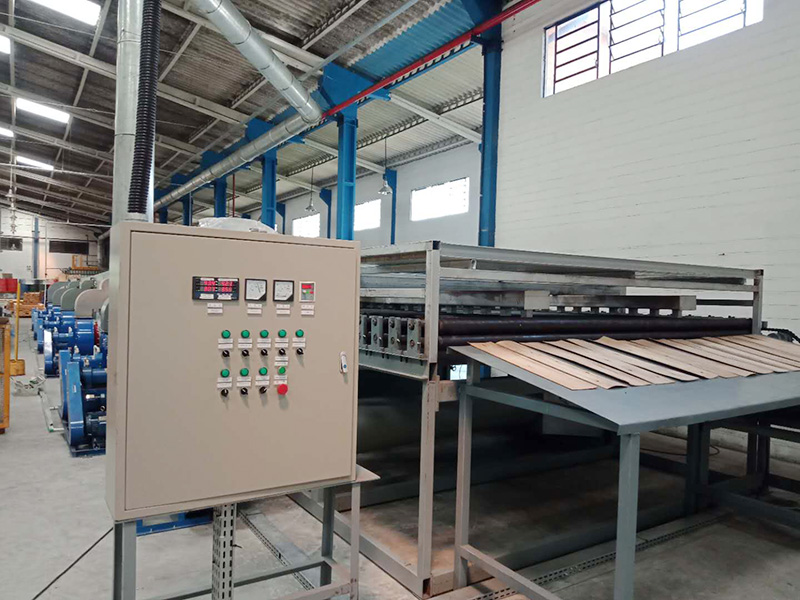
A veneer dryer should be evaluated as a system. The following checks are based on published parameters and configuration points across Shine’s roller veneer dryer listings and model pages.
Working width and sections: Match the dryer working width and the hot-air/cold-air section lengths to line layout and target throughput.
Moisture target: Shine publishes targets such as fresh veneer to about 10% (GTH30-20 and GTH30-28) and fresh veneers to within 12% (GTH612-42). Align targets with the next step in your plywood process.
Speed control range: Models list veneer speed ranges such as 5–22 m/min, supported by frequency control.
Fan configuration and total power: Confirm that axial flow fans are specified for hot-air and cold-air systems, and compare total power against published operating consumption.
Heating choice: If considering biomass heating, confirm fuel type handling assumptions (Shine describes crushed wood waste) and the published drying temperature range.
For product browsing by category, buyers often start from the main veneer dryer listing and then validate model-level parameters.
International buyers building a shortlist for a China veneer dryer manufacturer typically look for three practical signals: model transparency, configuration clarity, and delivery readiness.
Shine notes a standard installation period of approximately 40 days for its wood veneer dryers, attributing this to modular design and engineering team support. The same group of pages also describes mature international logistics, standardized packaging, and professional container loading solutions intended to maximize integrity during transportation and optimize sea and land transport costs.
For model-specific details referenced in this article, buyers can review:
Veneer Drying Equipment (GTH30-20)
Biomass Burner Veneer Dryer (GTH30-28)
6 deck veneer dryer (GTH612-42)
Roller Core Veneer Dryer Machine (core dryer application context)
It means the hot-air and cold-air circulation fans are specified as axial flow fans. Shine states this fan choice reduces power consumption and reduces the power of the whole machine.
Shine highlights an axial flow fan configuration with a 38% reduction in total power consumption, and also references a waste heat recovery system with a 30% reduction in energy consumption.
Because Shine publishes both total power and “power consumption (about kWh per hour)” for specific models, showing that operating electricity use can differ even when total installed power is similar.
Shine lists fresh veneer to about 10% moisture content for GTH30-20 and GTH30-28, and fresh veneers to within 12% for GTH612-42.
Shine describes frequency conversion control that can automatically adjust speed and temperature, and also mentions automatic temperature control and speed regulation in its biomass burner veneer dryer description.
For GTH30-28, Shine specifies 140–200°C adjustable.
Copyright By © Shandong Shine Machinery Co.,Ltd
 ไทย
 Indonesia
 Melayu
 Tiếng Việt
 Pусский
 Portugues
 Français
 Deutsch
 日本語
 한국어
 العربية
 Italiano
 Polski
 Nederlands
 Türk dili
 हिन्दी
 Ελληνικά
 Svenska
 Español



