In procurement, “automatic control” is easy to list and hard to evaluate. For buyers focused on plywood veneer drying, the real question is whether the control system is implemented in a way that supports stable daily output, consistent moisture results, and practical maintenance—because only then does a low failure rate become a meaningful, comparable purchasing signal.
This article uses published specifications and product documentation to show what to check in a Veneer Drying System, how to compare a roller line with a Vertical Veneer Dryer, and how fuel and layout choices affect a Low Cost Veneer Dryer strategy.

A veneer dryer machine runs in a production environment where veneer thickness and incoming moisture vary. In practice, the procurement value of an automatic control system comes from how it helps operators maintain stable process conditions without constant manual intervention. Industry literature has long associated automatic control with removing “guesswork” in veneer drying and improving process stability, largely by adjusting dryer behavior when moisture outcomes drift.
For buyers, the key is to translate “automatic” into checks that reflect real operation:
Control range and accuracy: Does the dryer publish a clear temperature range and a control tolerance?
Throughput control: Can the line adjust transport speed to match veneer thickness and moisture variations?
System consistency: Are temperature control and speed regulation described as a coordinated system to support consistent moisture outcomes during Drying Veneer?
One published example is the GTH30-36 roller dryer sold as a Low Cost Veneer Dryer Machine, which lists automatic temperature control and frequency-controlled speed regulation as part of its operating configuration.
Roller lines are commonly evaluated for continuous plywood veneer drying, where consistent feeding and stable hot-air delivery matter as much as nameplate capacity. The GTH30-36 (two-deck roller dryer) publishes parameters that allow buyers to connect automation claims to measurable operating settings.
Dryer type | Two-deck roller dryer |
Working width | 3 m |
Heating area length | 32 m |
Cooling area length | 4 m |
Veneer thickness | 0.8–8 mm |
Drying temperature | 140–200°C, adjustable |
Temperature control accuracy | ±5°C |
Veneer transport speed | 5–22 m/min |
Drying capacity | 50–60 m³/24h |
Total installed power | 92 kW |
Actual electricity consumption | About 65 kWh per hour |
Heat source | Biomass burner (other options available) |
Covered space | 42 m × 9 m × 3 m |
In buyer terms, these numbers help define whether a Veneer Drying System can be tuned to different veneer conditions. If incoming sheets are thicker or wetter, transport speed (5–22 m/min) provides an adjustment lever while the temperature setpoint remains within a defined, adjustable band (140–200°C). The published control accuracy (±5°C) also gives procurement teams a concrete way to compare “automatic control” across quotations.
Additional features described for the same machine include a heat exchanger that distributes hot air evenly, along with frequency conversion speed regulation to adapt feeding speed to veneer thickness and moisture.
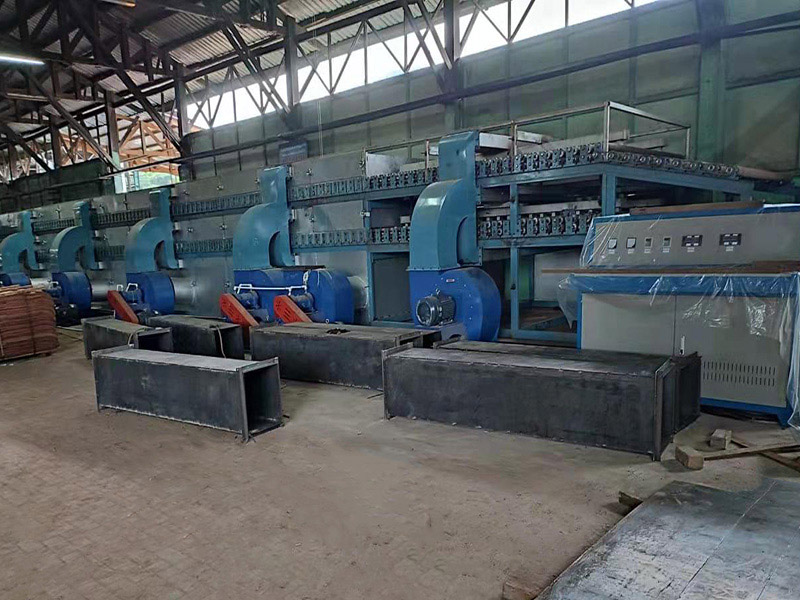
Published layout imagery can help buyers relate process controls to line arrangement and feeding logic.
A buyer can’t infer a low failure rate from “automatic temperature control” alone. Mechanical choices, component service routines, and how easily a line can be maintained under production pressure all influence downtime.
One example of maintainability-oriented design appears in documentation for a four-deck biomass dryer: roller construction uses φ102 steel special shaft tube, and bearings are described as resistant to 500°C high temperature and -20°C low temperature, with a daily-operation claim of no need injecting oil—a detail that matters because it reduces routine lubrication steps and can simplify daily checks.
This is where control specifications regain procurement value: when speed control and temperature control help the line run steadily, maintenance intervals become more predictable and operators are less likely to “fight the machine” with frequent manual changes.
Factory layout and labor planning often drive whether buyers select a roller line or a Vertical Veneer Dryer. Vertical designs are commonly evaluated when floor space is constrained or when a compact, continuous setup is preferred.
A Vertical Dryer Machine is described as using three-dimensional veneer loading and covering only two-thirds of the roller dryer’s area, with emphasis on thermal efficiency, low drying cost, and a quick-loading structure intended to save labor.

A footprint comparison can clarify whether compact vertical loading offsets lower line familiarity or different output expectations.
FBH30-13 is presented as a wood vertical veneer drying option with these specifications:
| Item | Published specification |
|---|---|
| Model | FBH30-13 |
| Moisture content | Fresh veneer dried to 0–5% |
| Output | 2 m³/h |
| Machine size | 13 × 3 × 4 m |
| Total power | 15 kW |
| Fuel consumption | 200 kg/h |
A separate vertical core veneer configuration (FBH30-20) publishes:
| Item | Published specification |
|---|---|
| Model | FBH30-20 |
| Moisture content | Fresh veneer to within 20% |
| Capacity | 1.2–1.5 m³/h |
| Overall size | 20 × 7 × 4 m |
| Total power | 36.3 kW |
| Labor | 3 workers |
For procurement, the takeaway is not which is “better,” but how each veneer dryer machine aligns with product requirements. A Vertical Veneer Dryer is also described as suitable for veneers with low flatness requirements and as requiring 2 workers per shift for one vertical tunnel-type core veneer dryer configuration.
When a buyer’s energy plan is built around wood residues, a biomass configuration can be evaluated as part of a Low Cost Veneer Dryer approach. A Low Cost Biomass Veneer Dryer (four-deck) is described as using a biomass burner that can burn waste wood directly to reduce drying cost. Its heat exchanger is described as adopting step-by-step heat transfer, with different specifications by section to help hot air emit uniformly to the veneer, with a flat drying effect.
Because fuel strategy and process stability interact, buyers assessing a Veneer Drying System typically confirm:
what fuels are intended for the burner,
how heat exchange and circulation are described,
how speed and temperature controls are expected to maintain uniform moisture during Drying Veneer.
Operating cost is often where control stability and reliability become measurable. One set of published figures frames the comprehensive drying cost at about 6–12 US dollars per cubic meter, explicitly including labor cost, fuel cost, and electricity cost. Vertical drying equipment is separately described as having drying cost less than $8/M³ and positioned as 30–60% of the drying cost of other dryers.
Installation planning can also influence uptime economics. For one veneer drying equipment description, installation is stated as feasible in 25–30 days, and service support mentions online video conferences for guidance including installation and commissioning steps.
For buyers comparing quotations, the most practical approach is to treat the control system as part of a complete purchasing checklist, not a standalone feature.
Temperature range and tolerance: Confirm the published range and accuracy (example: 140–200°C, ±5°C).
Transport speed window: Confirm speed range (example: 5–22 m/min) to handle variable veneer.
Capacity definition: Verify whether capacity is stated per hour or per 24 hours, and match it to production planning.
Moisture target: Confirm the finished moisture content range stated for the selected model.
Maintenance-related design details: Look for rollers, bearings, and daily-maintenance descriptions that affect downtime.
Operating cost basis: Ensure the cost per m³ includes labor, fuel, and electricity as defined.
Footprint and layout: Cross-check machine dimensions and site conditions.
For international procurement teams searching phrases such as “China veneer dryer manufacturer” or “China top veneer dryer factory,” the evaluation method matters more than marketing language. A veneer dryer machine becomes easier to compare when automation is expressed as specific, publishable ranges (temperature, speed, capacity) and when the vendor documents maintenance-related design choices, operating cost components, and installation expectations.
A consolidated product entry point for models and documentation is Veneer Drying Equipment. The manufacturer’s main website is https://www.veneersdryer.com/.
It becomes useful when it is published as measurable operating ranges—temperature, control accuracy, and transport speed—and when those settings are clearly linked to stable, repeatable plywood veneer drying conditions.
Not by itself. Low failure rate is typically evaluated together with mechanical design details, maintenance steps required in daily operation, and how consistently the Veneer Drying System can run at its intended settings.
Procurement teams commonly focus on the supported veneer thickness range, the adjustable temperature range, and the transport speed window, because these three directly shape how the line adapts during Drying Veneer.
A Vertical Veneer Dryer is often considered when floor space is limited and a compact three-dimensional loading structure is preferred, especially for applications described as having lower flatness requirements.
The published comprehensive drying cost per m³ is described as including labor cost, fuel cost, and electricity cost.
Yes. A four-deck biomass configuration is described as using a biomass burner that can burn waste wood directly, with a heat exchanger design intended to distribute hot air uniformly.
Copyright By © Shandong Shine Machinery Co.,Ltd
 ไทย
ไทย Indonesia
 Melayu
 Tiếng Việt
 Pусский
 Portugues
 Français
 Deutsch
 日本語
日本語 한국어
한국어 العربية
 Italiano
 Polski
 Nederlands
 Türk dili
 हिन्दी
 Ελληνικά
 Svenska
 Español


