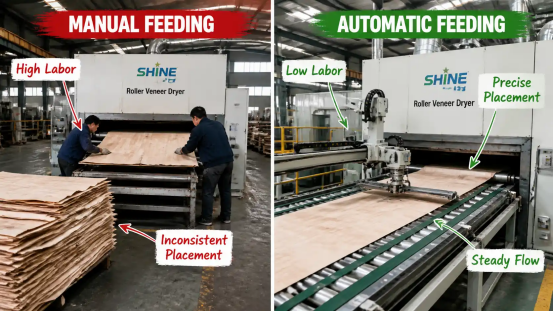
Rising labor costs are changing how plywood producers evaluate every part of the drying line. A modern automatic veneer dryer is no longer judged only by its heat source, deck count, or output. Buyers now look closely at how veneer sheets enter and leave the line, because manual feeding can become a daily production bottleneck. For a veneer dryer machine, automatic plate feeding and collection help reduce repetitive handling, improve sheet positioning, and keep the Roller Veneer Dryer running with steadier material flow.
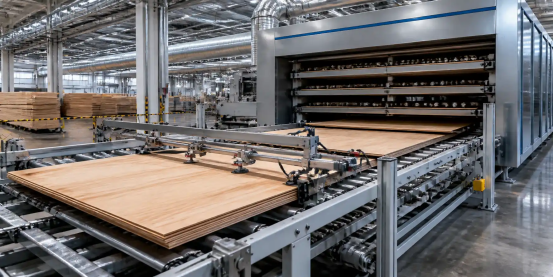
In a conventional Plywood Veneer Drying process, operators continuously place veneer sheets at the dryer entrance. The quality of feeding depends heavily on attention, timing, and consistent hand placement throughout an entire shift. When staffing is tight, this stage often impacts the rhythm of the entire wood drying machine.
Shine Machinery’s automatic veneer feeder is specifically designed to replace manual board feeding. The system requires only 1–2 personnel per end of the dryer, significantly reducing the need for continuous manual feeding work. It also aims to minimize deviation in veneer placement, support smoother veneer movement, and help prevent jamming during the drying process.
For plywood mills, this isn't just about a labor-saving accessory; it fundamentally changes the operating pattern around the veneer dryer machine. Instead of assigning workers to repetitive board placement all day, factories can leverage automatic feeding and collection to create a more stable material flow into the Roller Veneer Dryer.
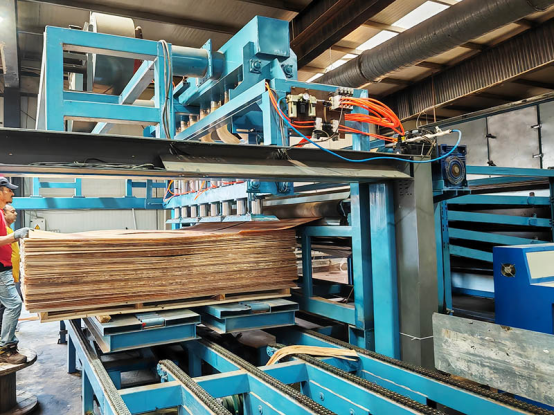
Shine Machinery ensures compatibility between its automatic loading system and 2-deck, 3-deck, 4-deck, and 6-deck veneer dryers. This offers buyers the flexibility to match the automation level with their Plywood Veneer Drying line's specific production scale.
The loading system integrates several robust drive components: a 3 kW lift servo motor, a 1.5 kW rubber-covered roller delivery system, a 2.2 kW two-deck belt transport motor, a 2.2 kW lifting-table chain, a 4 kW hydraulic pressure station, and a 2.2 kW traction motor, culminating in a total documented power of 15.1 kW.
Documented Point | Shine Automatic Loading System |
Main purpose | Replaces manual board feeding |
Staffing | 1–2 personnel per dryer end |
Dryer compatibility | 2-, 3-, 4-, and 6-deck veneer dryers |
Placement function | Reduces veneer placement deviation |
Operation support | Helps veneers run smoothly and prevent jamming |
Total loading-system power | 15.1 kW |
These specifics are valuable for buyers comparing a China veneer dryer manufacturer or supplier, as the automation package should be evaluated as part of the complete drying line, not merely as a separate add-on.
A frequent purchasing error is to assume the loading system will control final veneer moisture. In reality, the automatic loading system optimizes how veneer sheets enter the wood drying machine, while drying outcomes depend on factors like temperature, transmission speed, veneer thickness, and existing moisture conditions.
On Shine Machinery’s automatic veneer dryer, sophisticated electrical control and variable-frequency regulation adjust transmission speed and temperature based on veneer sheet conditions. The specified veneer thickness range is 0.8–8 mm, and the target moisture value is 0–12%. The dryer can utilize steam, heat-transfer oil, or biomass as heating sources. For buyers planning Plywood Veneer Drying, these specifications should be reviewed alongside sheet size, incoming moisture, deck count, and overall factory layout.
This distinction is crucial: the feeder ensures stable handling, while the veneer dryer machine manages the precise drying conditions. When both elements are configured correctly, the Roller Veneer Dryer can operate with fewer interruptions and more predictable production planning.
Shine Machinery indicates that its automatic plate feeding and collection system can increase production by 30% and reduce labor costs by up to 25%. These figures pertain to the documented Shine configuration and should be evaluated in relation to the full machine setup, veneer specifications, and specific operating conditions.
Energy performance is another aspect that warrants separate evaluation. Shine Machinery details a waste heat recovery system with a stated 30% reduction in energy consumption and axial flow fans with a stated 38% reduction in total power consumption on referenced configurations. These are distinct features from automatic feeding and collection, so buyers should avoid simply adding the percentages together as if they represent a single saving.
For larger-scale production planning, Shine’s 6 deck veneer dryer highlights the GTH612-42 configuration with 15–18 m³/h drying capacity, 160–180°C adjustable drying temperature, 5–22 m/min veneer speed, and integrated automatic temperature and speed control. It also includes automatic plate feeding and frequency-conversion speed regulation, making it particularly relevant for buyers seeking a higher-capacity Roller Veneer Dryer.
Before investing in an automated veneer dryer machine, buyers must clearly define their production requirements. This is particularly crucial when comparing equipment from a China top veneer dryer factory, as similar-looking machines might differ significantly in automation, heat source, deck structure, and control configuration.
Key points to confirm include:
· Required drying capacity and deck configuration.
· Veneer thickness range and incoming moisture condition.
· Final moisture target for the finished veneer.
· Whether automatic plate feeding and collection are required.
· Heat source preference, including steam, heat-transfer oil, or biomass.
· Transmission-speed and temperature control requirements.
· Factory space, installation conditions, and electrical configuration.
· Customization needs for components or electrical parts.
A comprehensive checklist helps buyers integrate the automatic loading system, dryer body, heat source, and control system into a cohesive Plywood Veneer Drying plan. It also mitigates the risk of selecting a wood drying machine based solely on headline output.
The primary value of automatic feeding and collection isn't just faster operation. It's about reducing reliance on constant manual handling. In markets where both labor availability and cost impact production schedules, the ability to minimize repetitive feeding work can significantly improve the daily economics of a veneer dryer machine.
Shandong Shine Machinery Co., Ltd. presents its automatic loading system as a practical solution for factories needing smoother feeding, reduced placement deviation, and fewer manual tasks around the Roller Veneer Dryer. Their automatic dryer configuration also combines adjustable drying control, multiple heat-source options, and automatic plate feeding and collection.
For international buyers, the optimal purchasing decision typically isn't the most automated machine on paper, but rather the configuration that precisely fits the veneer type, target moisture, production volume, and factory operating conditions. When these elements are aligned, automation can truly support a more stable, labor-conscious Plywood Veneer Drying line.
Shine Machinery documents that the automatic loading system requires 1–2 personnel per end of the dryer.
The documented automatic loading system can be installed with 2-deck, 3-deck, 4-deck, and 6-deck veneer dryers.
No. Automatic loading improves feeding and sheet positioning. Moisture results are managed through drying temperature, transmission speed, veneer thickness, and moisture conditions on the veneer dryer machine.
Shine Machinery lists a veneer thickness range of 0.8–8 mm and a target moisture value of 0–12% for the referenced automatic veneer dryer.
Shine Machinery states that automatic plate feeding and collection can increase production by 30% and reduce labor costs by up to 25%.
Copyright By © Shandong Shine Machinery Co.,Ltd
 ไทย
ไทย Indonesia
 Melayu
 Tiếng Việt
 Pусский
 Portugues
 Français
 Deutsch
 日本語
日本語 한국어
한국어 العربية
 Italiano
 Polski
 Nederlands
 Türk dili
 हिन्दी
 Ελληνικά
 Svenska
 Español


