A veneer dryer machine advertised with a 140–200°C adjustable temperature sounds like it should cover “most jobs.” In real plywood lines, however, that range is only a capability label. What determines whether Drying Veneer is repeatable is the relationship between temperature, transport speed, veneer thickness, and incoming moisture—and whether the mill can record and review those conditions when defects appear.
For procurement teams comparing a Veneer Drying System, the practical question is not “Does it reach 200°C?” but “Can it help the plant hold stable conditions and trace results—batch after batch—so operators can diagnose problems quickly?”

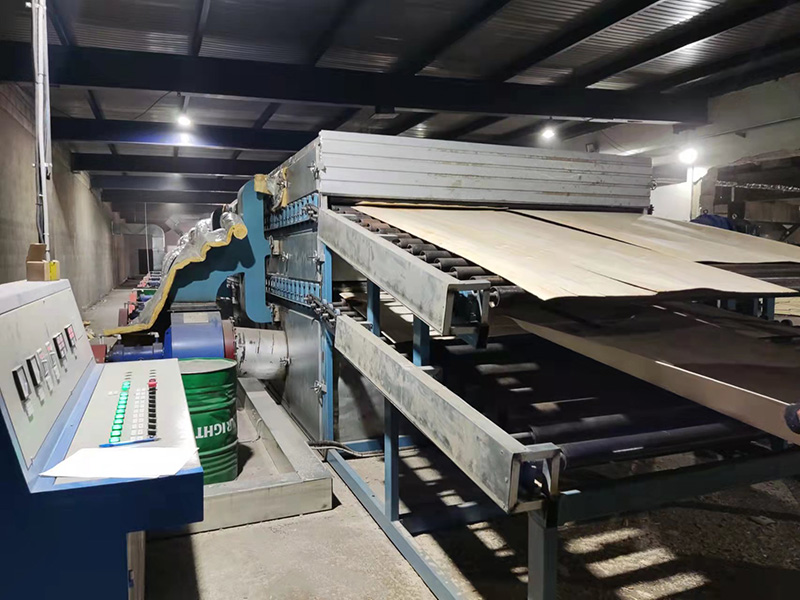
The temperature shown on a control panel is one operating input—not a complete drying schedule. Even when a dryer stays “within range,” mills can still see uneven moisture, ripples, wrinkles, or cracks because the same temperature behaves differently when other variables change.
A stable plywood veneer drying outcome depends on several coupled factors commonly managed on industrial lines:
Veneer thickness, which changes how fast moisture moves out of the sheet.
Incoming veneer moisture, which affects total moisture removal required.
Conveyor/transport speed, which sets residence time inside heating and cooling areas.
Airflow and circulation, which influence how evenly heat reaches the veneer surface and how effectively moisture is exhausted.
Target final moisture, which is defined by downstream needs such as gluing.
This is why operators often find that “140°C works on one batch” but needs adjustment on the next—especially if thickness or incoming moisture changes.
On Shine Machinery’s published parameters, the GTH30-40 model (a roller dryer configuration) illustrates how capability is defined by a set of numbers, not temperature alone.
One example is the link between thickness range, adjustable temperature, and speed:
Veneer thickness: 0.6–8 mm
Adjustable temperature: 140–200°C
Veneer transport speed: 5–22 m/min
Drying capacity: 55–65 m³/day
These figures are listed on the product page for the Plywood Veneer Drying Machine (Model GTH30-40). Procurement teams evaluating plywood veneer drying should read such specifications as a “window” into process control options—especially speed range and thickness coverage—rather than treating the temperature range as a universal recipe.
In many plywood operations, the biggest losses are not caused by one dramatic mistake, but by small shifts that are hard to notice in real time—then impossible to explain later.
That is where temperature recording becomes operationally valuable. Regulation and recording are different:
Automatic regulation helps the dryer maintain selected settings during production.
Recording creates a traceable history that supervisors can review when a batch shows defects or gluing problems.
A ±5°C temperature-monitoring target is often used as a practical internal review benchmark in factories building stronger traceability routines. It should be treated as a process-review tool—a way to spot departures from chosen conditions—rather than a universal threshold that prevents defects by itself.
When combined with final moisture checks and surface inspection, temperature history helps a team answer three questions quickly:
Did the process stay close to the selected setpoint?
If not, when did it drift (start-up, mid-shift, fuel changes, loading changes)?
Did that drift correlate with moisture variation, ripples, or cracking?

Selection decisions usually come down to veneer type, required flatness, footprint, and operating cost structure.
Roller dryers move veneer continuously through heating and cooling sections. Shine Machinery describes roller drying results for plywood preparation in terms of moisture uniformity and surface condition (flat veneer, no wrinkles or end ripples, no cracks, and a surface condition suitable for gluing). The GTH30-40 page also states it uses automatic electric control and frequency conversion, supporting coordinated adjustment of speed and temperature.
For buyers interested in higher-temperature stability and controlled heating, Shine’s thermal-oil option is presented on the 4 Deck Roller Veneer Dryer page. That product description highlights thermal oil running inside radiators for accurate temperature control and a uniform drying effect before gluing.
For core veneer, a Vertical Veneer Dryer is often evaluated for its compact layout and economical drying approach.
Shine Machinery’s vertical tunnel-type dryer is described as being used mainly for core plate, partial surface, and bottom plate, and as suitable for thick veneers in “cut first and then dry” production arrangements. The Vertical Veneer Drying Machine page also states that certain configurations report drying cost less than $8/M³, and notes loading-capacity advantages of 30–80% compared with other arrangements.
To keep comparisons concrete, the table below lists published parameters for two reference models.
| Item | Roller Dryer (GTH30-40) | Vertical Dryer (FBH30-13) |
|---|---|---|
| Working width | 3 m | — |
| Decks / structure | 2 decks | Vertical tunnel-type |
| Heating area length | 36 m | — |
| Cooling area length | 4 m | — |
| Veneer thickness | 0.6–8 mm | — |
| Moisture target (published) | Fresh veneer to about 10% | Fresh veneer dried to 0–5% |
| Total power (published) | 108.5 kW | 15 kW |
A Low Cost Veneer Dryer is often shortlisted when mills want roller-type production with controlled investment.
Shine Machinery publishes a roller configuration titled Low Cost Veneer Dryer Machine, listing:
Type: Roller Veneer Dryer
Working width: 3 m
Veneer thickness: 0.8–8 mm
Heating area length: 32 m
Drying capacity: 50–60 m³/day
Heat source: Biomass burner (other options available)
For buyers, the key is to evaluate “low cost” alongside the essentials for plywood veneer drying: whether the line can still support stable settings, consistent handling, and basic traceability records (temperature, speed, thickness, moisture in/out).
Whether the plant runs a roller system or a vertical core dryer, a lightweight recording routine can make troubleshooting faster and reduce repeated trial-and-error.
A typical batch record for plywood veneer drying focuses on linking inputs → settings → outputs:
Veneer thickness (batch range)
Incoming moisture condition (how wet the veneer is before drying)
Selected drying temperature and observed deviation (for review, often tracked against a ±5°C target)
Conveyor/transport speed (residence time proxy)
Final moisture check (spot checks from different positions)
Surface inspection notes (wrinkles, end ripples, cracks, flatness)
Batch ID and time window (for follow-up)
This approach supports actionable root-cause review:
Cracks may correlate with aggressive conditions relative to thickness and speed.
End ripples or waviness may signal uneven moisture removal or unstable settings.
Poor gluing condition often triggers a review of final moisture and surface state.
International buyers searching phrases like China top veneer dryer factory, China veneer dryer manufacturer, or China veneer dryer supplier typically want two things at once: competitive equipment economics and predictable production quality.
In practice, the most purchase-relevant questions are operational:
Can the selected Veneer Drying System match the plant’s veneer thickness range and throughput targets?
Does it provide the operator controls needed to coordinate temperature and speed?
Can the factory build a repeatable routine around temperature logging and moisture checks?
A 140–200°C veneer dryer machine range is a useful capability. The advantage comes when mills treat that capability as part of a controlled, recorded process—so quality issues become measurable, reviewable, and correctable.
A 140–200°C adjustable temperature range is listed for Shine Machinery’s GTH30-40 model. Appropriate settings still depend on factors such as veneer thickness, incoming moisture, transport speed, and the target moisture for downstream gluing.
A ±5°C temperature-monitoring target is commonly used as a practical internal benchmark for reviewing whether a dryer stayed close to the selected setting. It is most useful when paired with final moisture checks and surface inspection.
For the GTH30-40, published information describes drying fresh veneer to about 10% moisture. For the FBH30-13 vertical dryer, published parameters list fresh veneer dried to 0–5%.
Shine Machinery describes its vertical tunnel-type dryer as mainly used for core plate (and partial surface/bottom plate), suitable for thick veneers, and applicable where flatness requirements are lower.
Shine Machinery’s vertical dryer pages state that certain configurations report a drying cost of less than $8/M³, with loading capacity described as 30–80% higher than other arrangements.
Shine Machinery lists a roller-type Low Cost Veneer Dryer Machine with a 3 m working width, 0.8–8 mm veneer thickness range, 32 m heating area length, and 50–60 m³/day drying capacity, using a biomass burner (other options available).
Copyright By © Shandong Shine Machinery Co.,Ltd
 ไทย
 Indonesia
 Melayu
 Tiếng Việt
 Pусский
 Portugues
 Français
 Deutsch
 日本語
 한국어
 العربية
 Italiano
 Polski
 Nederlands
 Türk dili
 हिन्दी
 Ελληνικά
 Svenska
 Español



